

More robust, simplified EMC radar testing with R&S®RadEsT
Accelerate automotive radar testing under real-world EMC conditions with less complexity and greater reliability.

Accelerate automotive radar testing under real-world EMC conditions with less complexity and greater reliability.

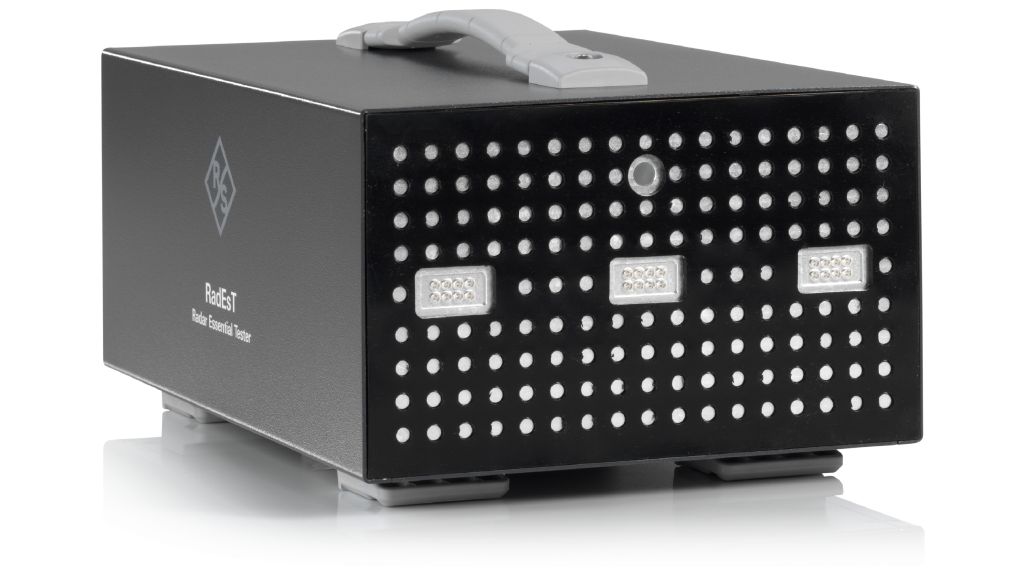
Compact and lightweight R&S®RadEsT radar essential tester;
dimensions (W × H × D): 186.5 mm × 138.6 mm × 275 mm (7.34 in × 5.46 in × 10.83 in); weight: 3.2 kg (8 lb)
Your task
Modern automotive radar sensors need to be reliable even in the presence of strong electromagnetic fields. Advanced driver assistance system (ADAS) functions, such as adaptive cruise control (ACC), automatic emergency breaking (AEB) and blind spot detection (BSD) have become critical to vehicle safety. Radar systems must maintain accurate range, angle and Doppler measurements while remaining immune to external RF disturbances.
ISO 11452 defines electromagnetic compatibility (EMC) and immunity requirements for automotive components, typically up to 100 V/m electric field strength. However, passing EMC limits is not enough to ensure proper radar detection. Strong RF fields can cause desensitization, reduced detection range, ghost targets or loss-of-object tracking – effects that have a direct impact on ADAS performance.
Typical challenge: At field strengths above 100 V/m, some radar sensors may momentarily lose targets or show degraded velocity accuracy – even though EMC immunity limits are met. Functional validation under EM stress is essential and sourcing test equipment for EMS testing chambers up to 200 V/m can be challenging.
The goal: ISO 11452 EMC compliance while validating true radar detection performance under electromagnetic stress conditions up to 200 V/m for reliable operation beyond normative EMC limits.
Rohde & Schwarz solution
The compact R&S®RadEsT radar essential tester closes the gap between classical EMC immunity testing and ADASrelevant radar performance evaluation. The tester can be directly integrated into existing EMC chambers, reverberation chambers or bulk current injection (BCI) environments without needing to modify electromagnetic (EM) field generation.
R&S®RadEsT provides:
Technical advantages of R&S®RadEsT
Operational advantages of R&S®RadEsT
Application
ISO 11452 – EMC testing for automotive radar sensors
ISO 11452 defines EMC immunity tests for automotive electronic subsystems, including radar sensors used in passenger and commercial vehicles.
Note: ISO 11452 validates EMC immunity but does not assess radar measurement accuracy. Radar functional performance must be evaluated in addition to EMC compliance.
Component-level testing (Tier 1)
Vehicle-level testing (OEM)
Radar sensors must remain fully functional under strong electromagnetic fields in ADAS vehicles. ISO 11452 compliance alone is not sufficient and engineers must validate real radar detection performance under EM stress to ensure safety and reliability.
The R&S®RadEsT is a powerful platform for comprehensive radar performance evaluation in EMC environments. R&S®RadEsT enables robust, reliable and future-ready radar systems with support for electric field strengths up to 200 V/m, real-time measurement of radar detection behavior and seamless integration into existing test chambers.
| Electromagnetic immunity test results | ||
|---|---|---|
| Test standard | Frequency range | Nominal electric field strength |
| MIL-STD-461G, RS103 | 2 MHz to 30 MHz | 200 V/m |
| MIL-STD-461G, RS103 | 30 MHz to 80 MHz | 200 V/m |
| ISO 11452-2, ed. 3.0 | 80 MHz to 1 GHz | 200 V/m |
| ISO 11452-2, ed. 3.0 | 1 GHz to 6 GHz | 200 V/m |
| MIL-STD-461G, RS103 | 6 GHz to 18 GHz | 200 V/m |
Related products
