
RF component testing

RF component testing

Speak to an expert

RF power amplifier testing

Power amplifiers play a vital role in RF systems, delivering the precise power levels needed for reliable transmission across a wide range of applications. Rohde & Schwarz offers comprehensive testing solutions that cover every stage of development, from wafer to design-in. Our approach ensures that your power amplifiers meet stringent performance and reliability standards.

Power amplifiers are a crucial part of any RF design. These essential components get the RF signal to the right power level for transmission and the strength the receiver needs to recognize and decode the signal.

Different target applications define the amplifier specifications and the amplifier type:

  • Amplifiers for integration in mobile frontends, such as those used in cellular phones, are optimized to provide sufficient modulation capabilities while maximizing power efficiency. This is essential for extending battery life in portable devices.
  • Amplifiers used in radar and electronic warfare applications focus on delivering maximum amplification and high output power. They place less emphasis on minimizing signal distortion to meet the demanding requirements of these specialized systems.
  • Low noise amplifiers often used at receiver frontends are evaluated based on key performance indicators (KPIs) like minimal noise contribution. Their primary role is to enhance signal sensitivity without introducing unwanted noise.
  • High power amplifiers for broadcast and infrastructure systems are designed to prioritize linearity, low signal distortion, and reduced power consumption. They help to maintain high-quality signal transmission and simplify thermal management in large-scale environments.

Rohde & Schwarz solutions help you verify your design with unmatched RF measurement performance and high test speed.

Learn more in our brochure "RF amplifier testing – from wafer to design-in".

Your amplifier design optimization and validation challenge

Testing power amplifiers spans from initial wafer fabrication to final integration into the targeted system application.

Development phase: Validation and optimization

During the development phase of power amplifiers, several key aspects must be validated and optimized:

  • Performance Validation: The first step is to confirm the amplifier’s basic performance, ensuring it operates reliably within its intended specifications. Advanced characteristics, such as linearity and modulation distortion, are analyzed to assess signal fidelity. This process includes verifying the effectiveness of performance-enhancement techniques, like linearization using Digital Pre-Distortion (DPD), which helps minimize distortion in complex modulation schemes.
  • Energy Efficiency: Energy efficiency is a primary focus in amplifier testing, as it represents a major competitive differentiator and is critical to a product’s market success. Efficient amplifiers contribute to longer battery life in portable devices and reduced operating costs in infrastructure applications.
  • Design Optimization: Fundamental design decisions are evaluated and refined, including the selection of the most suitable semiconductor technology for the target application. The process also involves investigating and fine-tuning circuit topologies, such as the Doherty design, to achieve optimal performance.
  • Doherty power amplifier design: The Doherty amplifier is a specialized architecture known for its advanced efficiency enhancement capabilities, especially when amplifying signals with high peak-to-average power ratios. Characterizing and optimizing Doherty amplifiers requires advanced test solutions that can precisely control the amplitude and phase of input signals for both carrier and peaking amplifiers to optimize their interaction, as well as analyze their combined performance. Effective Doherty amplifier design testing is essential for achieving high efficiency and reliability in modern communications systems.

Production phase: Ensuring Quality and Throughput

In production, it is crucial to ensure performance, reliability, and meeting stringent specifications across the value chain and to let only good parts go to the next step for being packaged and shipped to customers.

  • On-Wafer Testing:
    Early qualification of a device is crucial for minimizing costs if any issues arise. Testing begins at the wafer level, where either the device structure itself or dedicated test structures on the same wafer are verified to simplify the process.
    Process monitoring and basic tests are conducted using both DC and RF metrics to identify successful wafer runs and isolate faulty devices. Since device behavior can change after packaging, only fundamental RF tests, such as measuring S-parameters for gain and matching, are meaningful at this stage. In many cases, pulsed test scenarios are preferred to avoid significant self-heating of the test devices. With many devices present on a single wafer, efficient testing strategies are essential to keep test times manageable.
  • Full device validation:
    Once devices are packaged, comprehensive validation becomes mandatory to ensure that only high-quality products reach end customers. The validation process is tailored to the amplifier type and its intended use case, involving both continuous wave (CW) and modulated signal tests. These tests confirm that the device meets its promised specifications and performs reliably in real-world applications.

Our RF power amplifier testing solutions

Rohde & Schwarz offers a comprehensive set of test instrumentation optimized to address the challenges in RF power amplifier validation. Dedicated solutions are available for CW and modulated test for development with enhanced features and maximized RF performance in dynamic range and modulation quality. On the other side, throughput optimized instrumentation helps you to meet the production and characterization needs.

Rohde & Schwarz offers a comprehensive set of test instrumentation optimized to address the challenges in RF power amplifier validation. Dedicated solutions are available for CW and modulated test for development with enhanced features and maximized RF performance in dynamic range and modulation quality. On the other side, throughput optimized instrumentation helps you to meet the production and characterization needs.

  • Vector network analyzers (VNA) provide a wide test range, with a single connection enabling measurements from S-parameters through to gain compression over frequency, as well as linearity validation. The use of pulsed signals during testing helps prevent device overheating, which is particularly important when amplifiers are not yet equipped with proper cooling.
  • Load pull systems offer deeper insights into amplifier behavior and facilitate optimization for varying operating conditions. They also enable precise adjustment of termination for harmonic frequencies, ensuring the amplifier performs efficiently and reliably across its intended range.
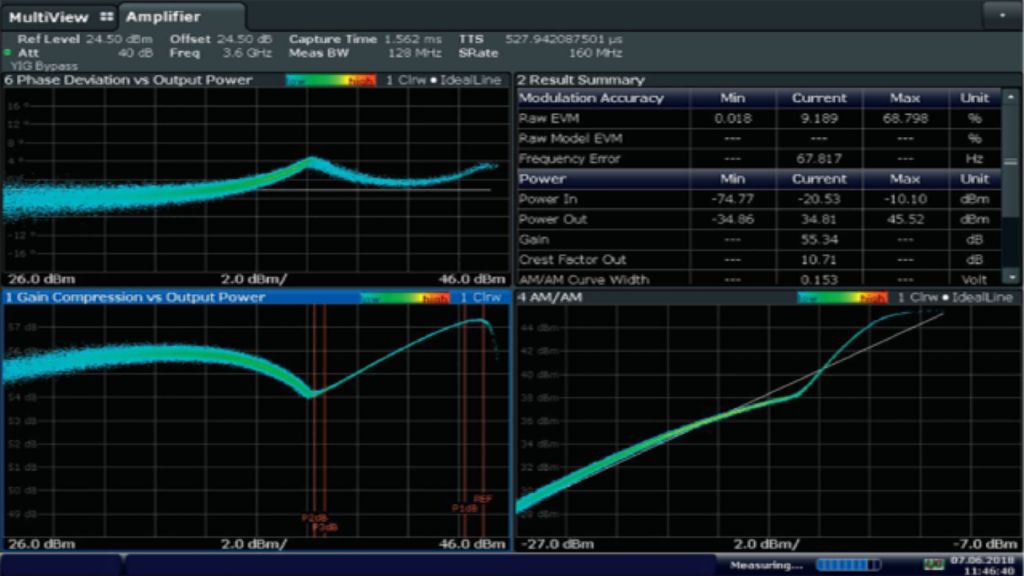
  • Modulation tests focus on key metrics for linear signal transmission, such as error vector magnitude (EVM) and adjacent channel leakage ratio (ACLR), which quantify signal quality and unwanted spectral regrowth. Modulation testing often includes linearization techniques to validate optimal operating conditions. Rohde & Schwarz’s industry-leading vector signal generation and analyzer solutions deliver unique features and the most comprehensive test capabilities available.
  • A wide range of power supplies is essential, as active devices like RF power amplifiers require multiple power lines for supply and biasing. Rohde & Schwarz offers various power supplies tailored to different technologies, including high-power and high-voltage solutions for next-generation GaN amplifiers, as well as cost-efficient options for standard biasing needs.
  • Dedicated throughput and cost optimized solutions are available for production and characterization environments. Rohde & Schwarz provides VNAs and vector component testers designed to maximize throughput and minimize costs, ensuring efficient and reliable testing for large volumes of devices.
Power amplifier efficiency optimization

Power amplifier efficiency optimization

While the target application dictates the RF requirements, efficiency and cost are the main differentiating factors for RF power amplifier solutions. Various techniques can be used to improve efficiency, e.g. technologies such as GaN with increased energy density. Envelope tracking optimize efficiency and digital predistortion (DPD) extend the linear range of amplifiers. Classic multipath structures such as Doherty and outphasing amplifiers are still state of the art in current designs.

RF power amplifier performance verification

RF power amplifier performance verification

When designing and using an RF power amplifier in a dedicated application such as a 5G base station, the system requirements for RF performance concerning EVM, ACLR, linear range, harmonics and output power are given. However, compliance with system requirements needs to be ensured.

Benefits of our RF power amplifier testing solution

The Rohde & Schwarz power amplifier test solutions support you in many ways for design, optimization and validation as well in production.

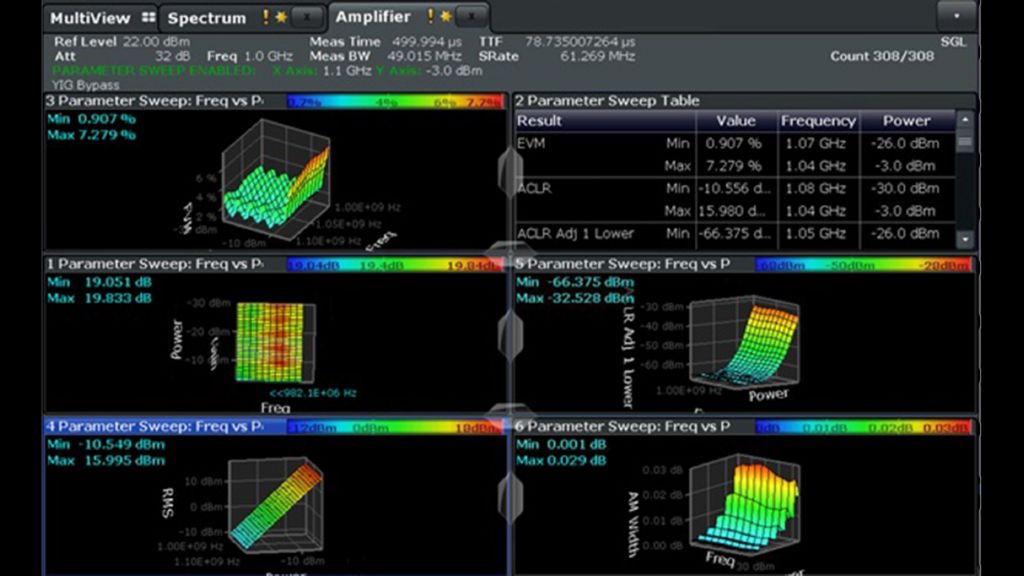
  • Full amplifier validation with one single connection: Using the R&S®ZNA performance VNA, comprehensive testing is possible from basic S-parameter measurements to non-linear performance validation, including gain compression. The instrument’s multiple sources enable harmonic active Load Pull, optimizing amplifier efficiency and supporting the creation of meaningful models.
  • Fastest production of RF frontends: CW-based test scenarios with the R&S®ZNB3000 VNA allow for rapid and reliable production testing of RF frontends, as proven in this session.
  • Industry-trusted modulation reference test system: The combination of the R&S®SMW200A vector signal generator and the R&S®FSW signal and spectrum analyzer provides a robust solution for standard-compliant test scenarios. This system offers leading EVM support and advanced linearization capabilities for thorough modulation analysis.
  • Industry-first integrated cross-correlation and residual measurements: The FSWX signal and spectrum analyzer features a dual-path concept, enabling integrated cross-correlation and residual measurements in one platform. This capability delivers unprecedented insights into device performance and characteristics.
  • High throughput modulation solution for production: The R&S®PVT360A performance vector tester utilizes comparable modulation and demodulation algorithms, ensuring a direct correlation between production and R&D test stations.
  • Highly accurate and extreme fast power measurements: The R&S®NRP three-path diode power sensors, developed by the inventor of the USB power sensor, deliver precise and rapid power measurements essential for both research and production environments.

Do you have further questions about our passive component testing solutions?

Then feel free to contact us.

White paper: Understanding EVM

White paper: Understanding EVM

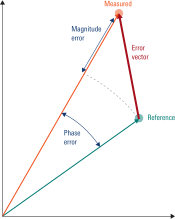
This paper provides an introduction to error vector magnitude (EVM), which is the primary metric of modulation accuracy. It discusses the fundamentals of the digital modulation schemes used in modern radio frequency communications systems, in particular, APSK and QAM, the fundamentals of error vector magnitude, and basics of constellation diagrams and how constellation diagrams can often be used to diagnose or troubleshoot the common root causes of EVM.

Sign up for our newsletter

Stay up to date on upcoming trends and latest applications.

Sign up for our newsletter

Request information

Do you have questions or need additional information? Simply fill out this form and we will get right back to you.
For service/support requests, please go here to log in or register.

Marketing permission

Your request has been sent successfully. We will contact you shortly.
An error is occurred, please try it again later.