5G NTN spectrum aspects
5G NTN spectrum spans FR1 (410 MHz to 7.125 GHz) and FR2 (24.25 GHz to 71 GHz). While early releases focused on FR1, recent work expanded into FR2, opening up Ka band NTN and Ku band refarming studies. FDD is the preferred choice for FR2 deployments, since long propagation delays make TDD switching inefficient. Future enhancements target higher frequencies, including the Upper C-band for supplementary downlink and the Q/V, E and D bands. To manage interference across these wide coverage areas, the industry employs specific metrics such as power flux density (PFD) and equivalent power flux density (EPFD). These spectral adaptations ensure that satellite communications can coexist with existing terrestrial and space-based services.
5G NTN architecture aspects
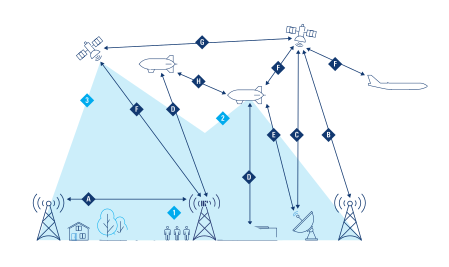
5G NTN architecture is organized into four segments: ground, air, space and network. This layout supports global coverage across single-operator, independent or shared multi-tenant deployments. Two satellite approaches exist. Simple transparent relays are fast to deploy but carry higher round trip time (RTT), while regenerative payloads offer onboard processing and lower end-to-end latency, at the cost of higher complexity. New UE types and services continue to emerge, bringing with them key challenges, such as:
- Latency and synchronization
- Feeder link capacity
- Mobility and security
Protocol stack supporting NR-NTN technology
NR-NTN impacts the entire 5G protocol stack, requiring coordinated adaptations end to end. At the physical layer, Doppler, long propagation delay and higher pathloss drive the need for advanced antenna systems, beamforming and better positioning. Higher layers require adapted timing, retransmission and buffering to handle long RTTs and intermittent feeder links. Timing offsets, such as Koffset, align scheduling over satellite links. Regenerative onboard processing can reduce end-to-end (E2E) latency and enable user equipment (UE) to store and forward services. Robust standards and comprehensive testing remain essential before wide rollout.
NR-NTN mobility procedures
5G NTN mobility adds new complexity, since satellites travel at high speed in addition to UE mobility. This leads to short visibility windows of satellites and an accumulation of handovers.
To address this, 3GPP introduced UE-centric mechanisms:
- Conditional handover
- RACH-less handover
- Layer 1/2 triggered mobility
- Updated measurement/reporting
These measures enable UEs to act on predictable conditions rather than instantaneous reference signal received power (RSRP). Satellite switch with resynchronization preserves cell identity during satellite replacement. Feeder link switchover (soft or hard) migrates the gateway, forcing transport and 5GC routing updates and potentially triggering group handovers. Reliable operation ultimately requires refined timing, signaling, orchestration and targeted testing.
NR-NTN protocol procedures and signaling details
System level protocol updates are central to reliable satellite 5G. Network assistance, through timing and ephemeris, helps UEs align uplink timing and compensate for Doppler effects, while scheduling and handover triggers ensure smooth mobility with fewer drops. Gateway switchover and core updates let operators reroute traffic seamlessly during satellite moves, and onboard processing and global navigation satellite system (GNSS)-resilient methods boost coverage and uptime. With rigorous timing, positioning, signaling and testing, these changes markedly improve NR-NTN reliability and reduce latency in applicable scenarios.
Test and measurement aspects
Test and measurement turn NR-NTN theory into a reliable service by validating radio frequency (RF) performance, timing, mobility and beamforming from prototype stages through conformance and operator acceptance. Because satellites move, tests emulate time-varying delay, Doppler and dynamic beam patterns. Labs combine conducted checks, over the air (OTA) chambers and channel emulators to reproduce real flight paths and fading. Repeatable automated test scenarios and industry-grade instrumentation make validation scalable, feeding directly into conformance and operator acceptance tests to accelerate certification. The outcome is faster, lower risk rollout of UEs and infrastructure with validated RF, mobility and E2E performance.
NTN outlook to 6G
6G is expected to treat satellites as first class native network nodes within a unified 3D architecture. The ITU's IMT-2030 framework envisions ubiquitous coverage, AI integration and integrated sensing and communications (ISAC), with multi-band, multi-layer networks combining terrestrial cells with HAPS/LAPS (high- and low-altitude platform stations) and LEO/MEO/GEO satellites. Regenerative payloads, inter-satellite links and onboard edge processing can reduce E2E latency and improve resilience, while AI-assisted predictive mobility and dynamic traffic steering are expected to improve capacity and efficiency. GNSS resilient positioning approaches and post quantum cryptography and quantum key distribution (QKD) options are being explored to strengthen trust and continuity. 3GPP, ITU and regional spectrum bodies are already defining requirements and roadmaps affecting 5G NTN architecture, opening substantial commercial opportunity where regenerative payloads, onboard processing and multi-orbit deployments meet the demands of latency, security and coverage.