AVQA - How proactive voice monitoring eliminated a silent threat

Case study

The hidden vulnerability in redundant systems

Air traffic control depends on radio communications working flawlessly every time. To ensure reliability, ANSPs deploy redundant systems. Primary and backup radios are used for critical frequencies, such as emergency channels. This redundancy creates a safety net, but it also masks a dangerous vulnerability: what happens when both systems fail simultaneously?

ROMATSA, like many other ANSPs, had invested in monitoring tools to track its communications infrastructure. However, after an AVQA demonstration, their engineering team wanted to validate whether any monitoring gaps existed. The question was straightforward: could issues be hiding in plain sight?

ROMATSA optimizes monitoring with AVQA
ROMATSA optimizes voice network monitoring with AVQA

Proof of concept deployment

ROMATSA requested a proof of concept (POC) to evaluate AVQA in their operational environment:

  • Live network deployment with a central monitoring probe
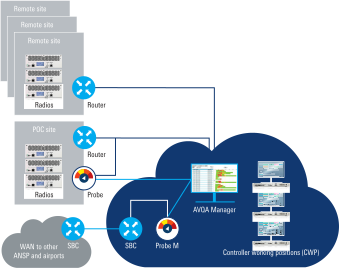
  • Continuous monitoring of approx. 350 radios across the network
  • Real-time voice quality metrics, including jitter, packet loss and mean opinion score (MOS)

At the conclusion of the POC, ROMATSA confirmed that AVQA provided a deeper analysis of their voice service than current systems. More importantly, it identified a critical blind spot: the ANSP’s existing tools were not monitoring what AVQA could see. The team requested that the system remain operational while it prepared for the formal procurement process. This decision proved to be groundbreaking.

AVQA proof of concept deployment

Air traffic controllers report radio failure

Air traffic controllers report radio failure Air traffic controllers reported that the transmit radios at one site were unavailable for a specific frequency. Pilots could not hear the controller well – obviously a critical safety issue requiring immediate action. The operations team followed standard procedures: they switched to backup radios and restarted the affected transmitter, which resolved the reported problem.

On the surface, this looked like a routine incident: one radio failed; backup systems engaged; problem solved. But the monitoring data from AVQA told a very different story.

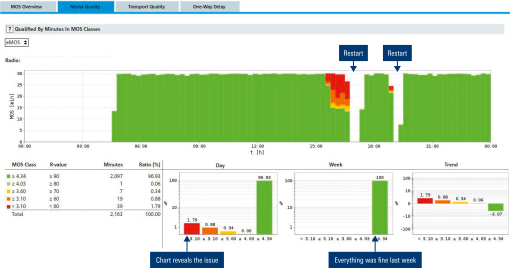
AVQA reveals the real scope While controllers reported a single radio failure, comprehensive monitoring from AVQA detected a more concerning issue. The system showed severe speech-quality degradation across multiple sites, with critical jitter levels (essentially, packet loss) affecting voice communications.

The AVQA impact analysis quickly identified:

  • Eleven affected radios (both transmit and receive)
  • Multiple sites experienced the same jitter conditions
  • Network-wide pattern indicating a systemic issue, not an isolated failure
  • Issue occurred over several hours before being reported

Safeguard emergency frequency

The critical discovery

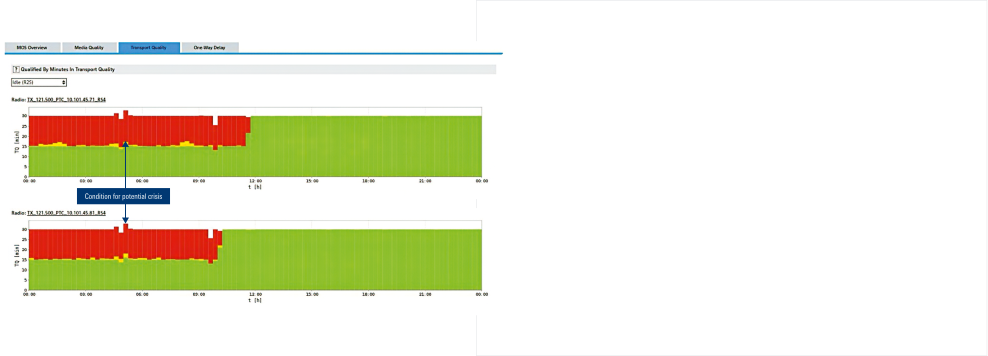
The most alarming finding emerged when engineers examined which radios were affected. Out of the eleven compromised radios, two were dedicated to the emergency frequency, and both the primary (MAIN) and backup (SPARE) emergency transmitters were experiencing degraded voice quality. This represented a potential crisis scenario: if an actual emergency had occurred during this window, controllers may have been unable to communicate effectively on the emergency frequency. The redundancy that should have protected operations had been silently compromised.

"I can share this story only because AVQA saved the day and helped eliminate this silent threat. AVQA demonstrated unique capabilities for voice monitoring. Current tools could not match what AVQA did."
Cristian Stan, voice communication engineer, ROMATSA

Comprehensive view of AVQA for early crisis prevention

Rohde & Schwarz solution

Comprehensive IP voice monitoring

AVQA provides continuous visibility that goes beyond other monitoring systems. The platform tracks voice quality metrics in real time across the entire radio infrastructure, enabling engineering teams to understand not just if systems are working, but how well they are working. Key monitoring capabilities:

  • Real-time voice quality metrics (MOS, jitter, packet loss, delay)
  • Network-wide visibility from a single monitoring point
  • Automated correlation across multiple affected sites
  • Historical trends to identify degradation patterns over time
  • Impact analysis showing which radios share common issues
  • Compliance verification in line with ED-136 and ED-137 standards

From detection to resolution

When air traffic controllers reported the initial radio failure, AVQA immediately confirmed and displayed a visualization of the issue in the dashboard. More importantly, it enabled the engineering team to ask the critical question: are other radios affected?

Within hours, the team had:

  • Identified all eleven affected radios across multiple sites
  • Discovered both emergency frequency radios were compromised
  • Correlated the pattern to identify the root cause
  • Implemented corrective actions across all affected systems
  • Verified restoration of voice quality through continued monitoring

Without the comprehensive view AVQA provides, this incident would likely have been classified as a single-point failure and marked as resolved. The compromised emergency systems might have gone undetected for days or weeks until needed in an actual emergency situation.

Benefits

Comprehensive visibility

The most significant outcome was crisis prevention. AVQA revealed that both primary and backup emergency frequency radios were compromised, a scenario that could have had serious safety implications if an emergency had occurred at the time.

What made the difference:

  • Network-wide correlation revealed the true scope of the issue beyond the initial report
  • Voice quality metrics detected degradation before complete failure
  • Impact analysis immediately identified critical systems at risk
  • The engineering team could act proactively rather than reactively

Operational efficiency gains

ROMATSA achieved measurable improvements in incident response:

  • Detection time: hours instead of days or weeks for multi-site issues
  • Problem scope: eleven radios identified versus one reported failure
  • Critical finding: both emergency radios were affected, invisible to other monitoring
  • Engineering efficiency: targeted resolution instead of trial-and-error troubleshooting
  • Operational safety: emergency communications capability maintained

Validated monitoring gaps

The proof of concept achieved its original goal: ROMATSA confirmed that AVQA filled critical monitoring gaps in their existing infrastructure. The platform provides:

  • Deep visibility into voice quality metrics, unavailable from radio equipment alone
  • Comprehensive network view from a single monitoring point
  • Automated correlation to identify systemic issues versus isolated failures
  • Proactive detection before issues impact operations
  • Standards compliance verification (ED-136, ED-137)

Summary

What started as a proof of concept became a demonstration of the importance of comprehensive voice monitoring in ATC. AVQA did not just detect an issue faster; it revealed an issue that other monitoring systems missed entirely.

For the ROMATSA engineering team, the incident validated their decision to proactively evaluate monitoring gaps. For air traffic controllers and the flying public, AVQA meant that emergency communications systems would be ready when they were needed.


Sign up for our newsletter

Sign up for our newsletter

Request information

Do you have questions or need additional information? Simply fill out this form and we will get right back to you.
For service/support requests, please go here to log in or register.

Marketing permission

Your request has been sent successfully. We will contact you shortly.
An error is occurred, please try it again later.