Satellite Testing

One trusted partner for satellite testing

From prototype to constellation

Speak to an expert

Reliable, compliant and scalable satellite testing

Non-terrestrial networks and multi-orbit constellations

Rohde & Schwarz is your one trusted partner across the testing ecosystem. Our solutions evolve with your satellite constellation, enable faster time-to-market, lower your operating costs and help ensure that each flight-ready unit meets the highest reliability and regulatory standards.

Demand for global connectivity, including satellite-based internet and mission-critical communications, as well as Earth observation and satellite navigation, has risen sharply. Low Earth orbit (LEO) satellites are key to this growth, providing low signal latency and path loss, high image resolution and lower launch costs. The industrialization of space presents satellite and user terminal manufacturers, as well as satellite network operators, with new challenges. These include high system complexity, cost pressure, short development cycles and limited engineering resources.

  • Increasing numbers of satellites in orbit The number of satellites in orbit has increased significantly over the past two decades, rising from a few thousand in the early 2000s to tens of thousands today. Driven mainly by LEO constellations, rapid growth is increasing pressure on manufacturers to scale production and testing efficiently.
  • Production is continuous and volumes are rising Individual LEO satellites remain in view for short periods only, meaning large constellations are required to provide continuous coverage. Their relatively high speeds create Doppler shifts that need to be accounted for in system design. Atmospheric drag limits the satellites’ lifespan, so new units must be continually produced and launched.
  • Satellites are downsizing LEO satellites - including mini, micro and nano satellites - tend to be smaller, ranging from a few hundred grams to around 500 kg. CubeSats are cost-efficient and versatile. Medium Earth orbit (MEO) and geostationary orbit (GEO) remain important, particularly in multi-orbit constellations, but account for a smaller share of new deployments.

Cube satellite on a laboratory test platform

Want to discuss your specific satellite test challenges with our experts?

Current trends in LEO satellite development

LEO satellite development is evolving rapidly, with new technologies and production models reshaping the way programs are designed and validated.

Current trends include:

  • Commercial off-the-shelf (COTS) components. Dedicated, highly robust radiation-hardened components are being replaced by mass-produced, cost-effective COTS components.
  • Intelligent payloads. Non-terrestrial networks (NTN) extend terrestrial 3GPP networks by integrating satellites across multiple orbits, providing coverage to remote and underserved regions. Payload architectures are evolving from bent-pipe relays to fully digital regenerative payloads with onboard processing, giving NTNs the potential to offer greater capacity, flexibility and network efficiency.
  • Constellation-level systems. With the focus now on constellations rather than individual satellites, reliability is achieved through system-level redundancy and resilience instead of single-unit performance.
  • A minimum viable product (MVP) approach. LEO development cycles are typically much shorter than those of GEO. An MVP approach enables manufacturers to incorporate insights from real-world performance into each new iteration.

These shifts require a new approach to New Space satellite testing. LEO satellite testing solutions (e.g., digital twins, test automation, data-driven optimization, AI/ML) can help manufacturers manage increasing complexity, make better use of limited engineering resources and accelerate time-to-market.

Meeting the challenges of mega constellations

As production volumes increase and reliability shifts from the individual unit to the constellation level, design, assembly, integration and verification processes must evolve accordingly. Current challenges include:

  • Scaling AIV for high-volume LEO production
    Traditional assembly, integration and verification (AIV) methods developed for GEO/MEO satellites are too costly and time-consuming for LEO constellations. Manufacturers need specific processes and methods that scale according to production volumes.
  • Ensuring constellation-level reliability
    In LEO, reliability is measured at a network level rather than by the performance of individual units. Uninterrupted service requires effective test systems and a clear understanding of fleet failure rates, supported by accurate measurement data across units and constellations

Understanding satellite testing expenditures

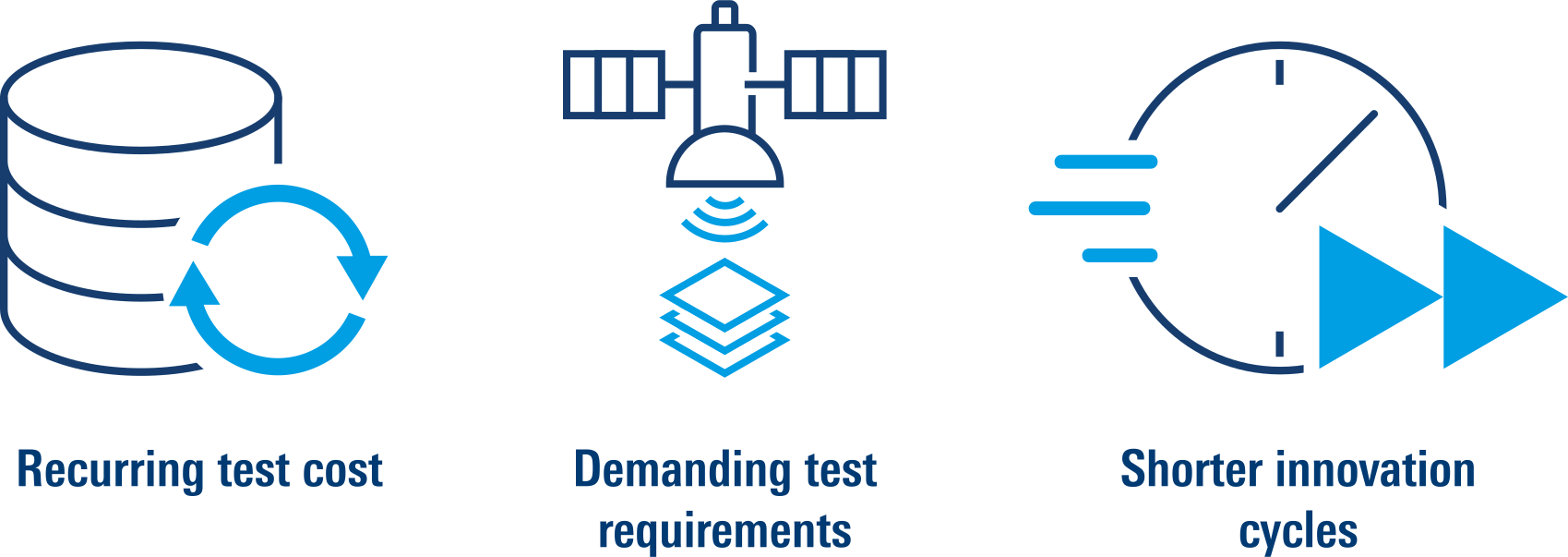
  • Recurring test cost (RC). LEO satellites must be constantly replaced, entailing significant RC. This can be mitigated by increasing throughput in production, managing complexity more effectively and implementing modular test systems that can be reused and adapted across variants and production stages.
  • Increasingly demanding test requirements. Modern LEO satellites handle higher data rates and integrate complex technologies, such as (1) multi-beam phased-array antennas, (2) higher frequencies for radio frequency (RF) and feeder links in Ka, Q/V and E-bands, (3) multi-Gbit/s digital interfaces, (4) RF and optical inter-satellite links, (5) advanced power systems and (6) software-defined payloads.
  • Shorter innovation cycles. The constant evolution of frequencies, bandwidths, modulations and other parameters means test equipment must be adapted accordingly.

To reduce CAPEX and optimize OPEX in satellite testing, companies should align their test strategies and platforms, foster automation across satellite production and implement flexible OPEX-optimized business models for test equipment.

Challenging test requirements

Implementing successful test strategies for LEO satellite projects

LEO projects, with their complexity and shorter development and iteration cycles, require earlier integration of testing and validation than traditional satellite projects. Unlike the traditional V-model of GEO testing - which separates design, implementation and satellite system validation - LEO satellite integration and test (I&T) adopts new methods. These integrate testing and validation from the early stages of development, enabling earlier error detection:

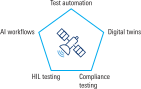
  • Virtualization and digital twins reduce reliance on hardware and facilitate incremental integration and validation.
  • Automated testing and reporting, modular test systems and data-driven optimization make test workflows faster, repeatable and reproducible from the earliest development stages.
  • Artificial intelligence (AI) can optimize designs and workflows by exploring solutions within goals and constraints defined by engineers. AI-driven anomaly detection reduces the risk of critical failures by helping to identify abnormal behavior in early test data.
  • Hardware-in-the-Loop (HIL) and Software-in-the-Loop (SIL) testing enable realistic, end-to-end satellite payload testing in the laboratory before deployment.
  • Satellite standards compliance testing of payload and bus communication systems (CCSDS standards, DVB-S2X, 3GPP NTN), electrical systems and EMC (ECSS-E-ST-20, MIL-STD-461, CISPR) as well as the RF spectrum (ITU regulations). These processes need to start early in the design process to avoid costly redesigns and schedule delays later in the program.

Ingredients for a successful LEO satellite test strategy

Satellite test solutions

Modern satellites combine complex RF & microwave systems, high-speed digital interfaces, power electronics, phased-array antennas, navigation receivers and advanced payloads. All need to be verified individually and as part of the complete satellite system. Rohde & Schwarz provides a broad portfolio of RF measurement equipment and satellite test solutions, enabling customers to build end-to-end satellite test ecosystems and supporting continuity across the full lifecycle.

Satellite test system

Want to discuss your specific satellite test challenges with our experts?

RF and microwave component test solutions

Rohde & Schwarz RF and microwave component test solutions deliver high accuracy, speed and modularity for RF and microwave component characterization and verification. Our testing portfolio includes:

Power electronics test solutions

Rohde & Schwarz power electronics test solutions support the validation of satellite electrical power systems (EPS), including batteries and power control and distribution units (PCDU). They provide high accuracy, versatility and modularity for demanding measurements such as power integrity , battery simulation and electromagnetic interference (EMI) debugging and analysis . This helps to ensure a reliable satellite power supply under demanding space conditions.

Relevant test solutions include:

Digital test solutions

Rohde & Schwarz offers digital interface test solutions for satellite data bus protocols (e.g., MIL-STD-1553A, SpaceWire, SpaceCAN, Ethernet, I²C, RS-422, JESD204C). They enable early analysis of digital interfaces and help identify signal integrity issues before they can affect system performance or reliability in orbit.

Key test capabilities for the analysis of printed circuit board (PCB) layout and interconnects include:

RF payload and communication system test solutions

Rohde & Schwarz RF payload and communication system test solutions support the validation of both traditional and digital or regenerative satellite payloads, as well as TT&C and bus communication systems. They enable key RF measurements such as modulation quality and error vector magnitude (EVM).

Solutions include:

EMC test solutions

Rohde & Schwarz satellite EMC test solutions support compliance testing in accordance with standards (e.g., ECSS-E-ST-20, MIL-STD-461, CISPR), covering both electromagnetic interference (EMI) and electromagnetic susceptibility (EMS) testing.

Rohde & Schwarz is the market leader for EMC test equipment and complete test systems, ranging from individual instruments to turnkey solutions.

The portfolio includes:

Transmit/receive module (TRM) and phased-array antenna test solutions

Rohde & Schwarz satellite TRM and phased-array antenna test solutions support characterization and validation from individual transmit/receive modules through subarrays to complete antenna systems. Testing can cover RF monolithic microwave integrated circuits (MMIC) such as beamformer integrated circuits (BFIC), subarrays with multiple antenna elements and selective over-the-air (OTA) measurements of full antennas in relevant beam configurations.

Key solutions include:

Global navigation satellite system (GNSS) receiver test solutions

Rohde & Schwarz GNSS receiver test solutions support R&D, validation and production testing of onboard satellite navigation receivers. They enable repeatable GNSS scenarios across multiple constellations, alongside interference and automated performance testing, all under controlled laboratory conditions.

Key test areas include:

  • GNSS scenario simulation for GPS, Galileo, GLONASS, BeiDou, NavIC and QZSS
  • Interference testing, including jamming and spoofing scenarios
  • Automated GNSS receiver performance testing

Our advanced multi-frequency GNSS simulators include:

Thermal vacuum chamber (TVAC) test solutions

Rohde & Schwarz TVAC test solutions support accurate RF power and S-parameter measurements over wide frequency and dynamic ranges inside thermal vacuum chambers.

Key solutions include:

  • R&S®NRPxxSN-V . Three-path diode power sensors, covering a dynamic range from -70 dBm to +20 dBm and frequencies from 50 MHz to 67 GHz
  • R&S®ZN-Z3x . Inline calibration units up to 40 GHz

Test solutions for production systems

Rohde & Schwarz system test solutions include:

We integrate our test and measurement equipment and system components into test systems according to customer-specific requirements.

The benefits of working with Rohde & Schwarz satellite experts

Rohde & Schwarz offers a broad portfolio of test and measurement solutions for satellite programs, supporting RF and microwave components, power electronics, EMC, signal and protocol testing across key verification and validation stages. With decades of experience in building and integrating test systems, we are the market leader for EMI and RF test and measurement solutions for satellite standards compliance testing.

We provide:

  • A broad offer: Our solutions portfolio encompasses a wide range of standards and performance requirements, from R&S®ESSENTIALS to best-in-class test and measurement solutions.
  • Reliable supply and flexible access: A carefully managed supply chain keeps delivery times to a minimum, while our rental partners maintain stocks of Rohde & Schwarz equipment for short-term or temporary requirements. Our equipment is manufactured in Germany and the Czech Republic, with a high level of vertical integration to ensure quality and reliability.
  • Worldwide support: Customers are provided with consistent application and service support throughout the lifecycle of their satellite programs.
  • AI workflows: Our test solutions and measurement instruments integrate AI capabilities in order to simplify operation, accelerate test-sequence creation and improve testing efficiency.
  • End-to-end traceability:Traceable calibration helps ensure consistent data traceability across measurement workflows.

Want to discuss your specific satellite test challenges with our experts?

Satellite testing FAQs

Our satellite testing solutions

Satellite payload testing

Test and measurement solutions for development, verification and production of satellite payload and communication sub-systems and systems.

More information

Satellite user terminal testing

Test and measurement solutions for satellite user-terminal development, verification and production.

More information

Satellite ground station testing

Test and measurement as well as security solutions for teleport and satellite network operators.

More information

5G NTN satellite testing

5G NTN test solutions for satellite infrastructure and mobile devices.

More information

Sign up for our newsletter

Sign up for our newsletter

Stay up to date on upcoming trends and latest applications.

Request information

Do you have questions or need additional information? Simply fill out this form and we will get right back to you.
For service/support requests, please go here to log in or register.

Marketing permission

Your request has been sent successfully. We will contact you shortly.
An error is occurred, please try it again later.