Reliable, compliant and scalable satellite testing
Non-terrestrial networks and multi-orbit constellations
Rohde & Schwarz is your one trusted partner across the testing ecosystem. Our solutions evolve with your satellite constellation, enable faster time-to-market, lower your operating costs and help ensure that each flight-ready unit meets the highest reliability and regulatory standards.
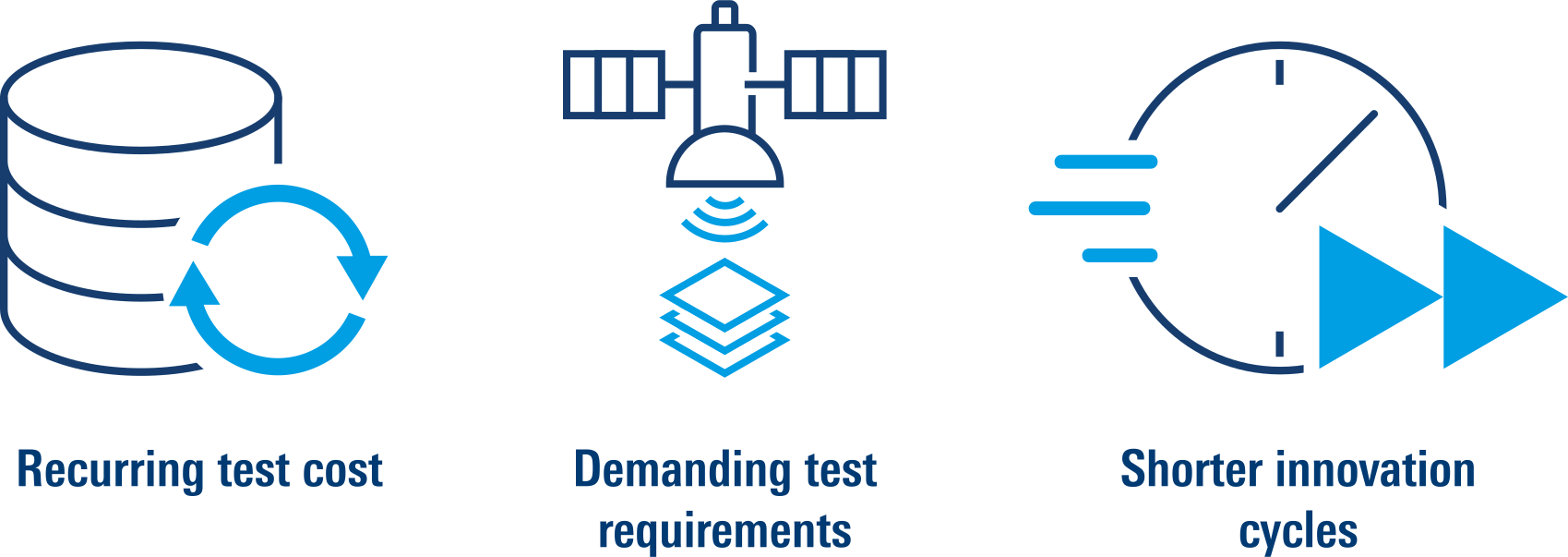
Demand for global connectivity, including satellite-based internet and mission-critical communications, as well as Earth observation and satellite navigation, has risen sharply. Low Earth orbit (LEO) satellites are key to this growth, providing low signal latency and path loss, high image resolution and lower launch costs. The industrialization of space presents satellite and user terminal manufacturers, as well as satellite network operators, with new challenges. These include high system complexity, cost pressure, short development cycles and limited engineering resources.
- Increasing numbers of satellites in orbit The number of satellites in orbit has increased significantly over the past two decades, rising from a few thousand in the early 2000s to tens of thousands today. Driven mainly by LEO constellations, rapid growth is increasing pressure on manufacturers to scale production and testing efficiently.
- Production is continuous and volumes are rising Individual LEO satellites remain in view for short periods only, meaning large constellations are required to provide continuous coverage. Their relatively high speeds create Doppler shifts that need to be accounted for in system design. Atmospheric drag limits the satellites’ lifespan, so new units must be continually produced and launched.
- Satellites are downsizing LEO satellites - including mini, micro and nano satellites - tend to be smaller, ranging from a few hundred grams to around 500 kg. CubeSats are cost-efficient and versatile. Medium Earth orbit (MEO) and geostationary orbit (GEO) remain important, particularly in multi-orbit constellations, but account for a smaller share of new deployments.