
Testing eXtended Reality (XR)

AI glasses, AI wearables and mobile XR testing

Speak to an expert

Always-on with AI and XR applications

AI glasses and personal AI wearables are emerging as a major new device category. From AI-enabled glasses to earbuds, pendants and pins, these devices are designed to deliver intuitive, always-on experiences in compact and lightweight form factors.

People today check their phones constantly, with the average person checking their phone 100-200 times per day. AI glasses can reduce the friction that is associated with repetitive smartphone use. In other words, they can reduce the number of steps required to do certain tasks. For example, using a smartphone to translate a menu in a foreign country involves taking out the phone, unlocking the phone, opening a translation app, turning on the camera and scanning the menu. With AI glasses, the translation could begin with a single voice or gesture command.

AI is a fundamental technology enabler for XR. AI technologies, such as computer vision and natural language processing, are central for XR. This means that tracking, real-world sensing and even voice control all require AI to work. 3D world building with generative AI is also expected to play a key role in XR experiences.

AI glasses rely on distributed computing architectures to balance performance, battery life and thermal constraints. Testing is therefore crucial to ensure that applications can maintain high performance as workloads move dynamically between device and network resources.
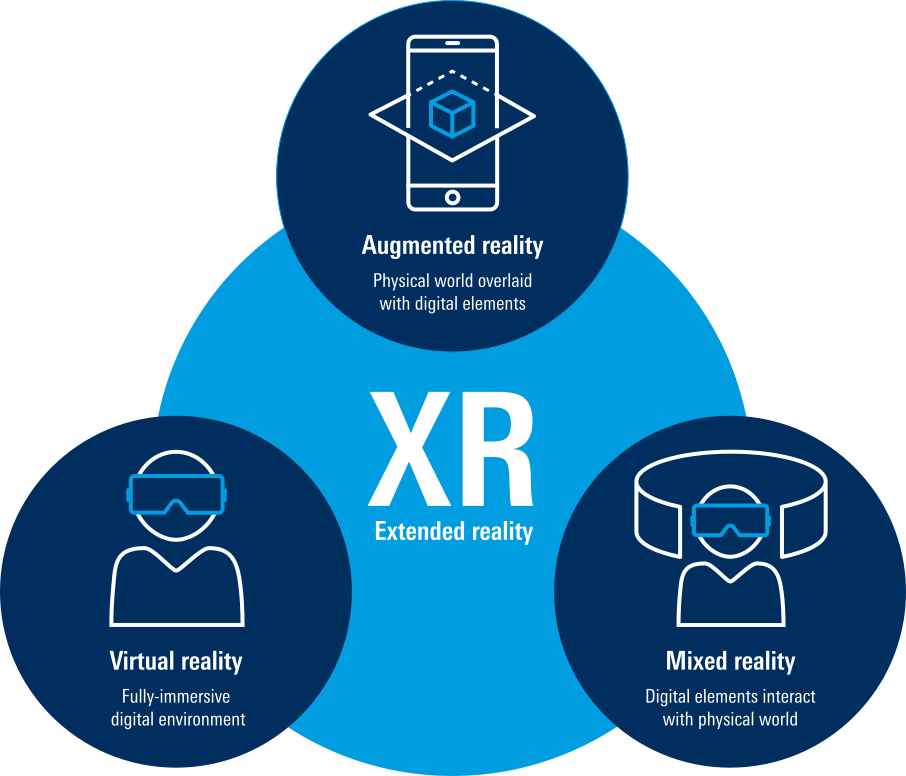
Extended reality (XR) serves as an umbrella term encompassing virtual reality (VR), augmented reality (AR), and mixed reality (MR).

AI glasses and 6G

Today, we’re already seeing the first generation of AI glasses. The long-term goal is to develop lightweight glasses with both AI and XR capabilities that are practical for all-day use. Such AI glasses have the potential to become the next major computing platform, especially with the rise of 6G.

The success of 4G LTE was built on a new device type - the smartphone - combined with use cases and applications enabled by this new device. 5G and 5G-Advanced are not associated with a new class of mobile device, but existing smartphone applications have benefited from the enhanced speed and capacity offered by 5G.

AI glasses are expected to become a computing platform with an impact comparable to the smartphone. The smartphone was the new device that supported the growth of 4G LTE. Similarly, AI glasses with XR capabilities have the potential to become the new consumer device type driving the success of 6G.

Industry organizations enabling the AI and XR device ecosystem

Industry organizations are key to building the ecosystem for AI glasses, AI wearables and mobile XR, as well as regulating how these new devices use 5G-Advanced and 6G networks.

  • 3rd Generation Partnership Project (3GPP) sets the global standards for cellular networks. Since Release 17, 3GPP has been introducing dedicated study and work items for XR.
  • Internet Engineering Task Force (IETF) maintains open internet protocols like TCP, UDP, QUIC and WebRTC. These protocols support low latency and high reliability, which are necessary to optimize quality of experience (QoE) for AI and XR applications.
  • Metaverse Standards Forum (MSF) is an organization that fosters collaboration and interoperability between companies and existing standards development organizations to support the advancement of an open metaverse.

#ThinkSix Tech Talk: Immersive experiences with XR

Mobile XR and AI Glasses - Part 1: An emerging platform for 6G use cases

Mobile XR and AI Glasses - Part 1: An emerging platform for 6G use cases

Watch Video

Mobile XR and AI Glasses - Part 2: 6G use case testing - challenges and solutions

Mobile XR and AI Glasses - Part 2: 6G use case testing - challenges and solutions

Watch Video

Your AI glasses testing challenges

Mobile XR and AI glasses present testing challenges due to application and wireless network complexities. The next generation of wearable devices depend on seamless interaction between on-device intelligence and network-based services. Use cases such as agentic AI assistants, live translation, contextual awareness and other advanced capabilities must perform reliably despite changing radio conditions, network congestion and shifting compute locations. This introduces a new testing challenge: verifying not only wireless connectivity but the full end-to-end behavior of distributed applications.

Critical validation areas include:

  • Application responsiveness across 4G, 5G and Wi-Fi
  • Adaptation to RF interference and network congestion
  • Switching between cloud, edge, local server and on-device processing
  • Latency-sensitive voice and AI interactions

Realistic 4G, 5G and Wi-Fi emulation for AI glasses, AI wearables and mobile XR device testing

Rohde & Schwarz provides a testbed setup for validating the performance of AI and XR applications on mobile devices and chipsets. At the core of this setup is the CMX500 5G one-box signaling tester . It emulates 4G, 5G and Wi-Fi networks for end-to-end (E2E) testing of AI and mobile XR applications.

This is a controlled environment for testing AI and XR devices. A controlled and repeatable lab setup allows developers to identify bottlenecks early, evaluate application behavior under challenging conditions and fine-tune performance before products reach the market.

This is especially valuable for:

  • Device manufacturers building AI wearables and mobile XR devices
  • Chipset suppliers validating connectivity and power-saving behavior
  • Application developers optimizing cloud-assisted AI and AR experiences
  • Network operators and infrastructure providers preparing for 5G-Advanced and future 6G use cases

The CMX500 allows the user to measure parameters such as throughput and latency while emulating congested networks or challenging radio frequency (RF) conditions. It is also possible to test the performance of specific applications under such parameters. This enables the verification of a robust and reliable user experience even under less-than-ideal circumstances.

Due to its parallel support of 5G and Wi-Fi, the CMX500 can run comprehensive interoperability and performance tests to check the offloading capabilities from cellular to non-cellular networks and vice versa. It is essential to verify that the transition does not affect an application’s performance.

The CMX500 can be used for 5G and Wi-Fi desense testing by creating controlled coexistence scenarios and measuring how one active radio affects the performance of another. It also supports distributed computing architectures by connecting wearable devices and application servers into a single application-aware test environment. This makes it possible to evaluate how applications behave (1) when wireless conditions change and (2) when compute workloads move between device, cloud, edge and local servers.

Benefits of our AI and mobile XR device testing solution

Our end-to-end testbed can be used to evaluate AI glasses and XR device-based applications and services in a controlled environment.

Benefits include:

  • Quality assurance: ensure reliable performance and quality of experience (QoE)
  • Support for emerging wearables: test not only AI glasses but also other wearables such as earbuds, pendants and pins in a unified framework
  • Distributed application validation: evaluate applications that rely on compute resources on the device and across cloud, edge and local servers
  • Future-ready development: prepare applications and devices for the evolution from 5G-Advanced to 6G with scalable, end-to-end test capabilities

Want to discuss your specific AI or XR device test cases with our experts?

FAQs for AI and mobile XR device testing

Subscribe

Sign up for our newsletter

Stay on top of the latest trends in wireless communications testing

Request information

Do you have questions or need additional information? Simply fill out this form and we will get right back to you.
For service/support requests, please go here to log in or register.

Marketing permission

Your request has been sent successfully. We will contact you shortly.
An error is occurred, please try it again later.