EW scenario generation and receiver testing

EW scenario generation and receiver testing

EMSO test solutions

Speak to an expert

Outsmarting the invisible: Electromagnetic environment simulation for EW testing

Evaluating EW systems across the full development and integration lifecycle

Today’s electromagnetic battlefields are dense, dynamic environments. Radar and electronic warfare (EW) systems need to detect advanced threats such as LPI emitters, stealth platforms and coordinated jamming amid complex overlapping signals.

Electromagnetic spectrum operations (EMSO) are enabled by EW systems such as ELINT/COMINT receivers, Radar Warning Receivers (RWR) and jammers. Advanced testing at every stage of development is crucial to ensuring their readiness for operational use.

Want to discuss your specific EW simulation test challenges with our experts?

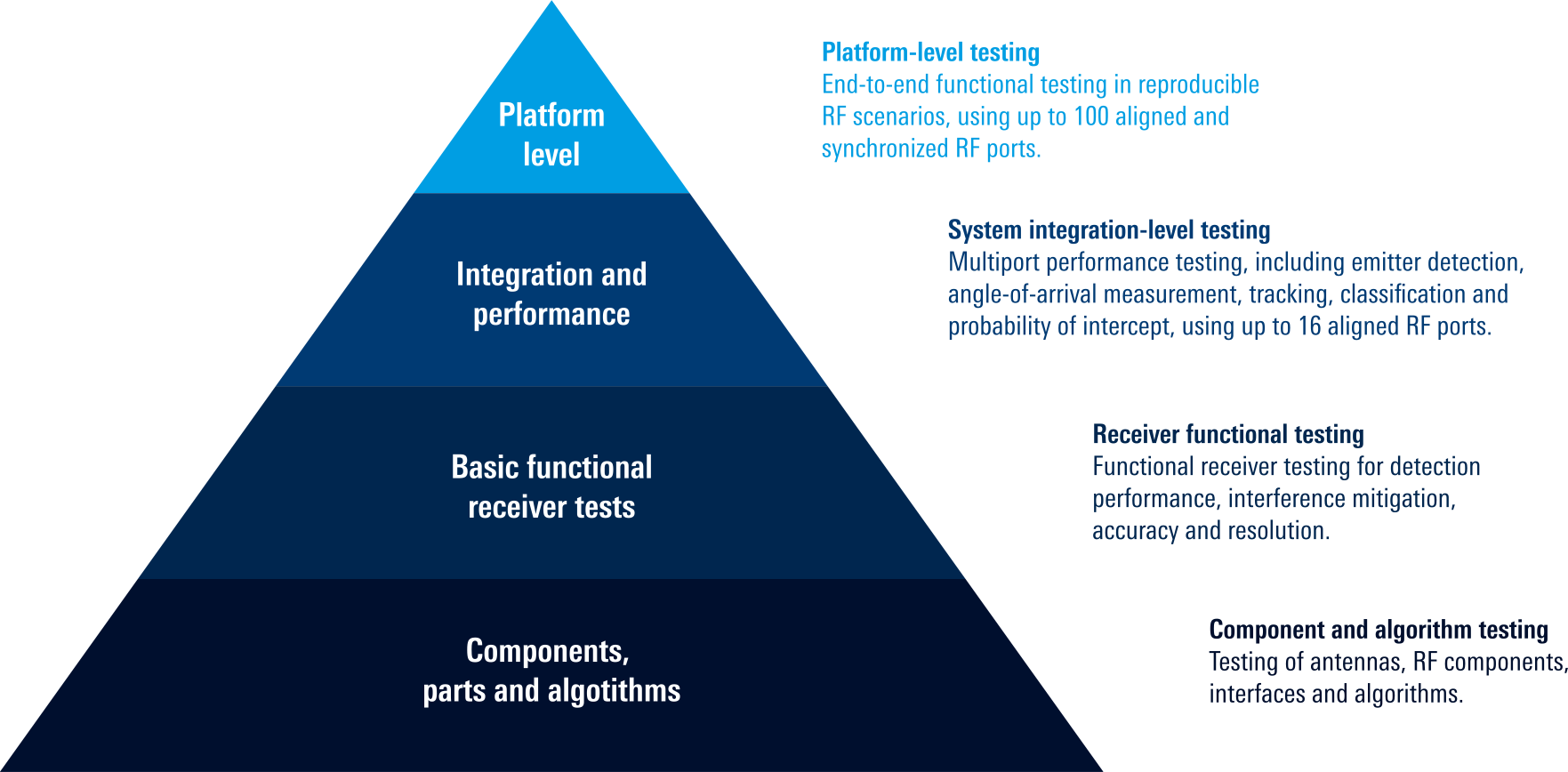
EW receiver testing at every stage

Test levels for EW receivers and systems

From open-air ranges to simulated RF environments

While basic integration and performance tests are carried out in the lab, platforms are traditionally evaluated at open-air ranges (OARs). Testing at OARs comes with certain drawbacks, such as expense, limited repeatability and potential exposure to electronic eavesdropping.

These challenges can increasingly be addressed through a shift toward real-world scenario testing in simulated RF environments, which provide repeatability, protection against signal interception and reduced test time and cost.

Simulation of electromagnetic environments

An electromagnetic environment setup typically consists of two main elements: a scenario simulation executive (usually a PC) and an RF-generating system. The system under test (SUT) is connected to the generating system via RF.

Electromagnetic environment simulation test setup

Scenario generation is based on maps, descriptive emitter models and customer-specific threat libraries. The resulting scenarios can can be uploaded or streamed to the RF-generating system as Pulse Descriptor Words (PDW), I/Q signals or a combination of both.

  • Pulse Descriptor Words are highly data-efficient and enable complex multi-emitter scenarios to be generated and streamed in real time.
  • I/Q signals require more data but can reproduce specific emitter characteristics with greater precision.

When pulses from several emitters occur at the same time, systems with a single PDW interface have to choose which pulse to generate, leading to lower-priority pulses being dropped. Signal generators with multiple PDW interfaces, however, can generate “pulse-on-pulse" signals, where multiple signals are combined without interleaving to create a more realistic scenario.

For more on the trade-offs and dependencies associated with test system architectures, discover our whitepaper series on electromagnetic environmental simulation for EW systems .

Test architectures for EW environment simulation

For simple receiver tests, benchtop systems with one or two signal generators are sufficient. Platform-level integration and beyond require high-density emitter test systems capable of simulating more complex scenarios.

There are two main categories of test architectures for EW environment simulation:

  • Open-loop systems, which test the SUT against long, pre-calculated scenarios, and analyze the results after the test rather than in real time.
  • Hardware-in-the-Loop (HIL) or System-in-the-Loop (SIL) test environments, which use the SUT’s response as feedback. The analysis and monitoring system feeds this response back to the scenario executive, which then adapts the threat mode accordingly.

For more information about HIL testing, download our whitepaper “ Generation of Radar Signals in a Hardware in the Loop (HIL) Environment ”.

Open-loop or closed-loop testing

The RF environment test system can be connected to the system under test (SUT) either by cable, using direct injection, or over the air (OTA).

To find out more about the respective pros and cons of both methods, read part 1 of our whitepaper series on electromagnetic environmental simulation for EW systems .

Direct injection setup and OTA setup

Challenges in electromagnetic environment simulation

Radar and EW systems need to be highly reliable in mission-critical situations, hence the need for thorough pre-deployment testing in realistic conditions. However, testing is becoming more challenging as the electromagnetic spectrum grows more complex, with advanced communications, navigation and EW systems operating across land, air and space. Lab-based testing of modern electronic warfare systems therefore involves the simulation of highly complex, rapidly changing scenarios. These scenarios may involve:

  • Wartime Reserve Modes (WARM), which can use classified frequencies and operating parameters, making the electromagnetic spectrum unpredictable.
  • Electronic Order of Battle (EOB) information, which is complex and dense and depends on databases being efficiently kept up to date with adversary electronic emitter data.
  • More recent cognitive EW systems, which learn from their surroundings to make predictions and adapt their behavior accordingly, requiring test environments to become more dynamic and responsive. This is driving a shift in learning and testing frameworks from open-loop toward System-In-the-Loop (SIL) mixed-fidelity test systems.

COTS-based, open-architecture test setups can provide the scalability needed as programs develop, while engineers continue to manage technical challenges such as multi-channel calibration, phase instability and pulse dropping.

Qualification of multi-channel direction finding radar receivers in the lab

Qualification of multi-channel direction finding radar receivers in the lab

Read about how Kongsberg Defence & Aerospace selected a radar test setup from Rohde & Schwarz based on the R&S®SMW200A vector signal generator for high-performance multi-channel, phase-coherent radar signal generation in this case study.

Technical and commercial trade-offs of EW environment simulation

Simulating an EW environment relevant for testing means balancing technical performance against commercial realities such as budget, schedule and scalability. The following challenges need to be taken into account:

A need for earlier testing integration

The traditional V-model, with its strict separation of design, implementation and system validation, was the standard for many military development projects. Increased complexity alongside shorter development and iteration cycles means that verification and validation must be integrated much earlier into the development process.

Recently, the industry has seen a “shift left” of integration and testing (I&T), which enables errors to be detected and rectified earlier.

High signal density

Replicating modern high-density electromagnetic spectrums and threat scenarios involves the generation of a high volume of signals, placing significant demands on RF generation architecture.

Signal generators with multiple PDW interfaces can reduce the number of RF ports needed to generate these scenarios, lowering hardware requirements, system complexity and costs.

Technical and operational challenges

Electromagnetic environment test system engineers, lab managers and buyers need to balance a range of technical, operational and commercial factors, including:

  • Calibration and multi-RF port misalignments, which introduce unintended amplitude, timing and phase differences across RF ports.
  • Phase stability and environmental drift, which can cause short- and long-term phase variations.
  • High pulse density and pulse dropping, which can reduce signal fidelity when hardware limits are reached.
  • Technical and usability trade-offs, including setup complexity and the balance between SWaP-C and performance.
  • Long lead times, which can result from custom hardware requirements and export regulations such as ITAR.
  • Computational and scenario complexity, driven by the need to simulate multi-emitter moving platforms in 3D space with six degrees of freedom (6-DOF) and complex antenna scans.

Rohde & Schwarz helps engineers and lab managers address these challenges with advanced hardware and software solutions that are designed to support performance, cost and schedule targets.

Outsmarting the invisible: How Rohde & Schwarz supports EW system manufacturers

Rohde & Schwarz offers EW simulation and test systems with short lead times, including configurations that are not subject to ITAR, helping customers simplify procurement and reduce program risk. Our solutions combine scenario generation, RF signal generation, multiport calibration and phase-coherent operation.

Want to discuss your specific EW simulation test challenges with our experts?

Examples of multi-channel RF environment simulation solutions from Rohde & Schwarz

Electronic warfare test systems for high-fidelity EW simulation

We offer highly scalable setups that range from one up to 100 RF ports, covering applications from basic component testing to complex scenarios.

High-fidelity scenario creation
The R&S®Pulse Sequencer software enables engineers to create realistic 3D scenarios featuring multiple moving emitters and receivers with six degrees of freedom (6-DOF).

Pulse-on-pulse scenario generation
The R&S®SMW200A vector signal generator provides up to six PDW interfaces, enabling pulse-on-pulse scenarios with up to six independent emitters and 2 GHz bandwidth on a single RF port.

Calibration and RF port alignment
Rohde & Schwarz calibration solutions combine R&S®ZNA or R&S®ZNBT vector network analyzers, RF and microwave power meters and R&S®RF Ports Alignment (RFPAL) software to align amplitude, phase and time delay across all RF ports.

Phase coherence and stability
A shared local oscillator (LO) signal, such as that provided by the R&S®SMA100B RF and microwave signal generator, can be distributed in a star configuration to maintain phase coherence and stability across the system.

Broadband and agile performance
The R&S®SMW200A combines a frequency range up to 67 GHz (72 GHz overrange), 2 GHz internal modulation bandwidth plus PDW and I/Q operation for simulating frequency-agile radars and high-density emitter scenarios. The R&S®SMM100A and the R&S®SGT100A provide a more basic EW feature set for I/Q-based signal generation.

Multiple data paths
Rohde & Schwarz signal generators support real-time PDW streaming for dynamic and long-duration scenarios, pre-calculated ARB replay for complex I/Q waveforms and Timed Control Descriptor Words (TCDWs) for deterministic changes to RF settings during a simulation.

Want to discuss your specific EW simulation test challenges with our experts?

EW simulation FAQs

EMSO testing solutions

Electromagnetic spectrum operations (EMSO) testing

More information

EMC testing for aerospace and defense

More information

Radar transceiver testing

More information

Antenna testing for aerospace and defense

More information

Rohde & Schwarz defense newsletter

Sign up for our newsletter

Stay up to date on upcoming A&D trends and latest applications.

Request information

Do you have questions or need additional information? Simply fill out this form and we will get right back to you.
For service/support requests, please go here to log in or register.

Marketing permission

Your request has been sent successfully. We will contact you shortly.
An error is occurred, please try it again later.