Technical and commercial trade-offs of EW environment simulation
Simulating an EW environment relevant for testing means balancing technical performance against commercial realities such as budget, schedule and scalability. The following challenges need to be taken into account:
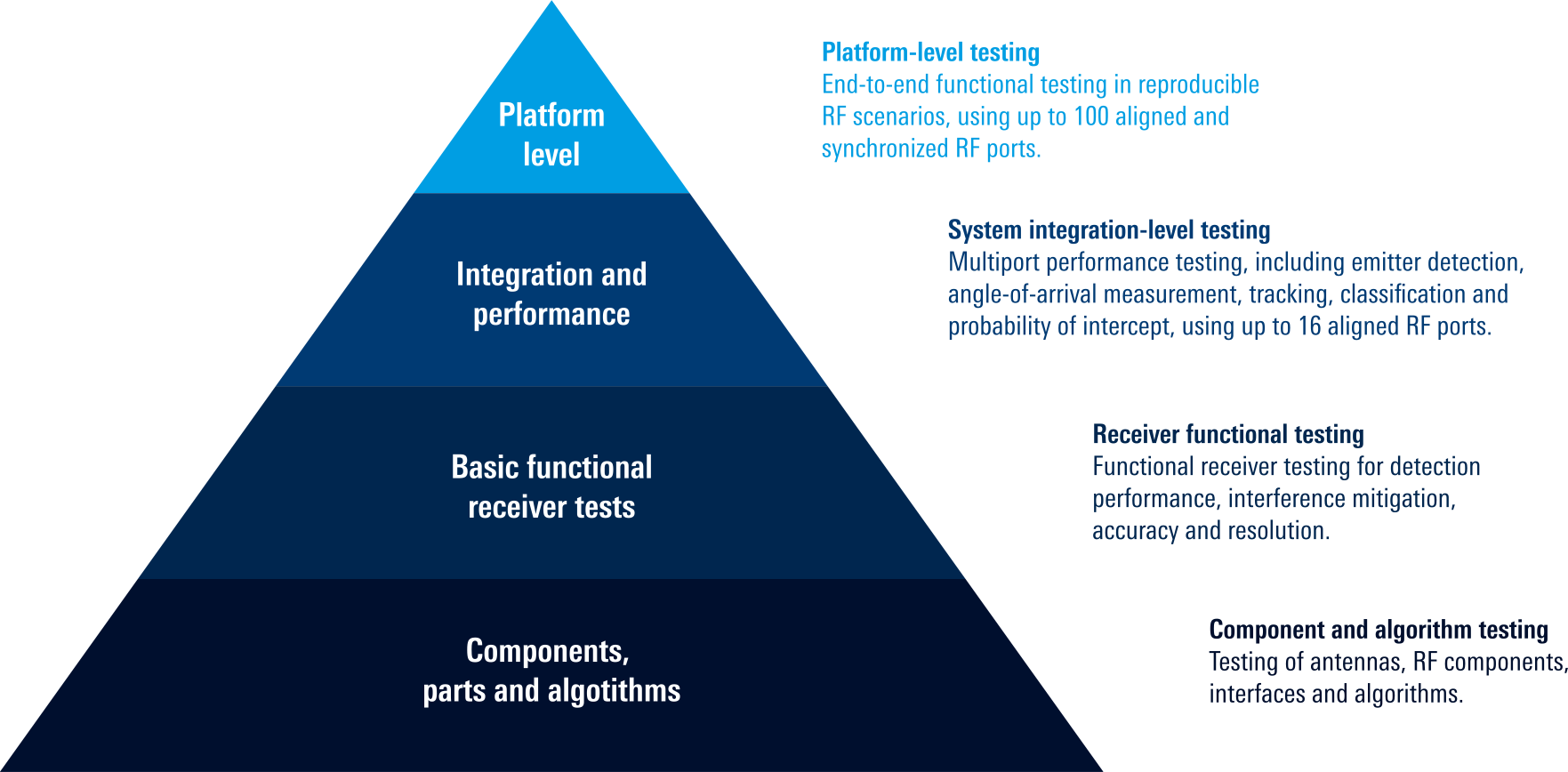
A need for earlier testing integration
The traditional V-model, with its strict separation of design, implementation and system validation, was the standard for many military development projects. Increased complexity alongside shorter development and iteration cycles means that verification and validation must be integrated much earlier into the development process.
Recently, the industry has seen a “shift left” of integration and testing (I&T), which enables errors to be detected and rectified earlier.
High signal density
Replicating modern high-density electromagnetic spectrums and threat scenarios involves the generation of a high volume of signals, placing significant demands on RF generation architecture.
Signal generators with multiple PDW interfaces can reduce the number of RF ports needed to generate these scenarios, lowering hardware requirements, system complexity and costs.
Technical and operational challenges
Electromagnetic environment test system engineers, lab managers and buyers need to balance a range of technical, operational and commercial factors, including:
- Calibration and multi-RF port misalignments, which introduce unintended amplitude, timing and phase differences across RF ports.
- Phase stability and environmental drift, which can cause short- and long-term phase variations.
- High pulse density and pulse dropping, which can reduce signal fidelity when hardware limits are reached.
- Technical and usability trade-offs, including setup complexity and the balance between SWaP-C and performance.
- Long lead times, which can result from custom hardware requirements and export regulations such as ITAR.
- Computational and scenario complexity, driven by the need to simulate multi-emitter moving platforms in 3D space with six degrees of freedom (6-DOF) and complex antenna scans.
Rohde & Schwarz helps engineers and lab managers address these challenges with advanced hardware and software solutions that are designed to support performance, cost and schedule targets.