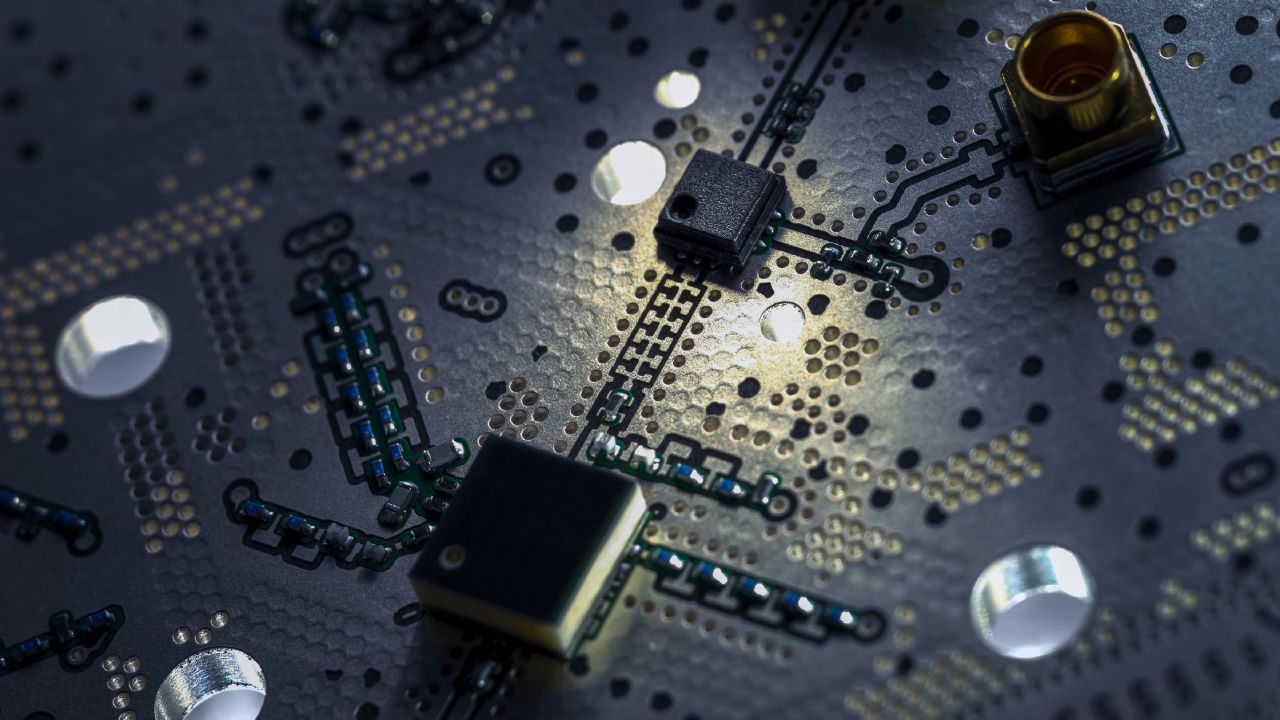



What are passive components and why do they need attention?
Passive RF components, such as filters, PCB’s and connectors, are crucial for signal integrity and system reliability. Rohde & Schwarz delivers trusted, advanced solutions for passive component testing, ensuring the highest quality and performance standards.
Passive components are electronic elements in an RF system that operate without the need for an external power source. Unlike active components, they do not generate or amplify signals; instead, they filter or direct RF signals.
Common passive components in RF and microwave systems include filters, combiners, couplers, cables, connectors, and capacitors.
In modern communication systems, even minor deviations in passive components can result in losses, distortions, or unexpected resonances. Passive component testing ensures that each component meets design specifications, maintains high-quality standards, and performs reliably under real-world conditions.
Key characteristics are evaluated through S-parameter (Scattering parameter) measurements, which provide critical performance metrics such as impedance, insertion loss or return loss.
Is S parameters all you need for passive component testing?
Yes and no. S-parameters (Scattering parameters) are extremely important and often the core of validation for passives in RF circuits such as filters, couplers, combiners, capacitors, inductors, transmission lines, and many more, but they aren't always all which is needed.
Why are S-parameters crucial for passive device validation?
S-parameters are crucial because they characterize a component as a “black box”. Without requiring knowledge of its internal structure, they provide an outside view of any two- or multiport device as a network.
They further describe how a component affects signals across a range of frequencies – which is especially important since passive components rarely behave ideally and their performance changes with frequency. This makes S-parameters a core instrument in modern device testing, revealing how a component's characteristics vary across its operating spectrum.
They are also essential for determining how a component matches its surrounding circuit, minimizing reflections while maximizing power transfer through impedance matching.
Additionally, S-parameters are critical for assessing the stability of RF circuits containing passive components. And they are widely used to generate accurate simulation models, such as SPICE models, enabling reliable prediction regarding the behavior of multiple interconnected components at system level.
What S parameters do not directly capture
- DC parameters: These include values such as voltage and current ratings, insulation resistance, the resistance of resistors, as well as inductance and capacity. They are typically measured by LCR meters.
- Power handling: Passive components can change their behavior when subjected to maximum input RF power compared to low power levels. Acoustic wave filters are a notable example of this effect.
- Non-ideal behavior: This refers to effects such as the creation and amplification of harmonics or different behavior with increasing power levels. S-parameters are inherently a linear measurement and cannot characterize these non-linear effects, which require specialized test setups to observe.
- Temperature coefficient: S-parameters change over temperate: Standard S-parameters represent a component's behavior at a single, specific temperature, so multiple measurements in a thermal chamber are required to characterize performance across a full temperature range.
- Aging of components: Aging refers to the process by which a component's characteristics degrade over its operational lifetime. S-parameter measurement provides only a snapshot of performance at one point in time, while assessing aging is typically done with stress tests over varying temperatures and high power levels.
- Time domain characteristics: They describe how a component’s voltage and current respond to changes over time, rather than its behavior at a steady frequency. Direct measurement is typically performed using oscilloscopes.
S-parameters are an important measure for passive component validation. However, they are not always giving the full picture. The specific tests needed will depend heavily on the component type, the operating environment, and the criticality of the application.