
Satellite navigation pocket guide

Satellite navigation pocket guide

Master GNSS fundamentals and advanced testing techniques

Download now

An illustrated overview of satellite-based PNT technologies

Authors: Dr. Markus Irsigler, Robert Obertreis

Explore the core principles of position, navigation and timing (PNT) with this concise, illustrated guide to satellite-based navigation technologies. You’ll learn about global systems (GPS, Galileo, GLONASS, BeiDou), receiver technology and augmentation methods to improve positioning accuracy. The guide also details GNSS vulnerabilities and threats like jamming and spoofing, alongside essential interference mitigation and testing procedures.

Inside, you’ll find:

  • GNSS fundamentals: GNSS principles, components and applications
  • System types and positioning accuracy: Stand-alone and augmented systems, satellite positioning, accuracy factors and various methods to improve positioning accuracy, including ionospheric corrections
  • Global systems and signals: GNSS signal characteristics and global systems, such as GPS, Galileo, GLONASS and BeiDou
  • Receiver technology and vulnerabilities: GNSS receiver technology, along with GPS vulnerabilities and threats, and interference mitigation technologies
  • Advanced applications and testing: Special GNSS applications, as well as simulation and testing methods, including automated and real-time kinematic (RTK) testing

Get the pocket guide now and equip yourself with a clear, concise reference for satellite-based PNT technologies.
Introduction to navigation satellite systems

Navigation satellite systems are crucial for accurate navigation and positioning. They provide essential data for many applications, such as:

  • Autonomous driving
  • Unmanned autonomous systems (UAS)
  • Transportation
  • Aviation
  • Farming
  • Timing services
  • Disaster management
  • Security services
  • Scientific research

Global navigation systems consist of multiple satellites distributed among various orbital planes to ensure worldwide coverage and availability. Satellite orbits can also be designed and optimized for regional coverage so that the positioning service is limited to dedicated areas.

Figure 1: Overview of navigation satellite systems

Satellite-based positioning

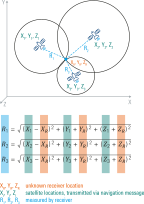
Satellite-based positioning works on the principle of trilateration. A navigation satellite receiver receives signals from multiple satellites, each providing the current time and location of the satellite at that instant. The receiver can calculate the distance to the satellite from the time of arrival (ToA) because the signal travels at a known speed - the speed of light. Once the distances from the receiver to three satellites are known, the receiver can determine its own three-dimensional position (latitude, longitude and altitude) through trilateration.

Figure 2: Trilateration is the basic principle of satellite-based positioning.

In addition to these three satellites, a fourth satellite is necessary to account for time discrepancies between the clock of the receiver and the precise atomic clocks of the satellites. This basic principle forms the foundation for all radio navigation satellite service (RNSS) systems.

There are different types of GNSS positioning methods:

  • Standalone GNSS
  • Augmented GNSS
  • High-precision GNSS

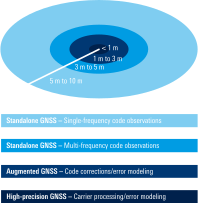
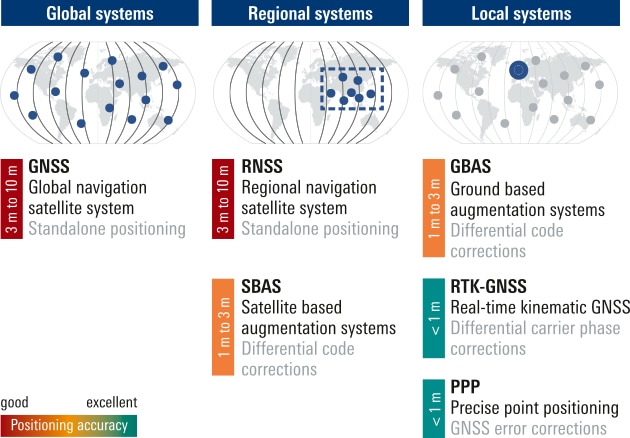
Figure 3: Positioning accuracy from standalone to high-precision GNSS

All these methods vary in their correction type (OSR versus SSR), observable type (code versus carrier), service area (local, regional or global), error mitigation capabilities and resulting positioning accuracies. If sub-meter accuracy is needed, carrier-based positioning is mandatory. High-precision GNSS methods offer varying accuracies. PPP services offer several decimeters, and PPP-RTK services provide better than 10 cm. RTK provides the best accuracies in the centimeter range, but it requires proximity to a reference station. For a balance of accuracy and infrastructure complexity, PPP-RTK is often the preferred choice, offering high accuracies with potential global coverage.

Global and regional navigation satellite systems

GNSS stands for “Global Navigation Satellite System”. There are several different types of GNSS, often operated by different governmental bodies.

For example:

  • GPS: Operated by the United States, specifically the US Department of Defense. While it was initially developed for military use, it was later made available for civilian use as well.
  • Galileo: Operated by the European Union. It is designed for civilian use and complements GPS and GLONASS systems.
  • GLONASS: Operated by the Russian Aerospace Defence Forces. It is designed to operate independently of other navigation systems.
  • BeiDou: Operated by China. It includes satellites in geostationary and non-geostationary orbits.
  • NavIC/IRNSS: Operated by the Indian Space Research Organisation. It primarily serves the Indian subcontinent.
  • QZSS: Operated by Japan. It complements GPS, enhancing availability and accuracy in the Asia-Oceania region, especially in urban areas with tall buildings.

A satellite-based augmentation system (SBAS) is a geospatial technology that provides corrections to GPS, GLONASS, Galileo and BeiDou systems to improve accuracy. It uses ground-based reference stations to derive differential corrections for GNSS satellites and broadcasts these corrections via geostationary satellites.

GNSS receiver technology

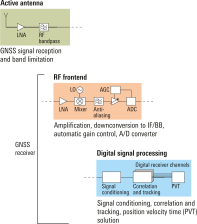
The basic architecture of a GNSS receiver can be divided into the following function blocks:

  • Antenna: GNSS antennas are right-hand circularly polarized (RHCP) and work in the L band frequency range. Their primary role is to optimize the capture of signals from satellites at higher elevation angles, while reducing the impact of multipath signals that often come from lower angles.
  • Preamplifier: The preamplifier section may be part of the antenna hardware and consists of a low-noise amplifier (LNA), filters for jamming/interference rejection and burnout protection.
  • Frontend: This section performs all analog signal processing tasks such as filtering (suppression of out-of-band interference), further amplification and down conversion to an intermediate frequency (IF).
  • A/D conversion: The analog IF signal is digitized in the A/D converter section.
  • Signal processing: Digital signal processing includes Doppler removal, mixing the signal with the ranging codes and sample accumulation to form correlation values. The signal processing unit provides pseudorange, carrier phase and delta-ranges as basic GNSS observables.
  • PVT processing: The basic GNSS observables are used to compute a position, velocity and time (PVT) solution. This can be achieved by solving the GNSS observation equations by means of least-square adjustments or by applying more advanced methods such as Kalman filtering.

As options, external sensors and other data sources can be included for calculating the PNT.

Figure 4: Block diagram of a generic GNSS receiver

There are several types of GNSS receivers, each designed for specific applications:

  • Survey-grade receivers: geodetic surveying, construction and other applications that require centimeter-level accuracy
  • Mapping-grade receivers: GIS data collection, agriculture and forestry
  • Marine GNSS receivers: specifically for maritime navigation and fishing applications
  • Aviation GNSS receivers: aircraft navigation, landing and other flight operations
  • Automotive receivers: built-in navigation for cars and other vehicles
  • Personal/handheld receivers: smartphones, fitness watches and other portable devices
  • Timing receivers: accurate time references for telecommunications, power grids and other infrastructure
  • Space-based receivers: orbital navigation and timing in satellites and support for science missions

The type of GNSS receiver will dictate its specific features and performance characteristics. Typical GNSS receiver specifications include channels, frequency coverage, sensitivity, accuracy, update rate, time to first fix (TTFF) and GNSS compatibility.

GNSS vulnerabilities and threats

Interference and influences of various types can cause signal degradation and errors in PVT information calculation. It can even lead to denial of service in certain areas.

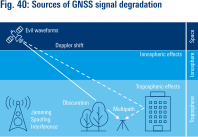
The sources of signal degradation can be divided into three categories:

  • System-inherent signal degradation caused by the satellites, infrastructure and architecture
  • Signal degradation along the signal path caused by atmospheric layers, Doppler shift and space weather phenomena
  • Signal degradation due to the user environment - not only buildings and trees but also multipath propagation and jammers

Figure 5: Sources of GNSS signal degradation

Signal degradation due to the user environment can be further differentiated in terms of type, cause and effect. The cause can be distinguished between intentional and unintentional interference, which both lead to signal degradation or denial of service. On the other hand, there are threats that aim to deceive the position of a receiver, which is known as spoofing.

Special GNSS applications

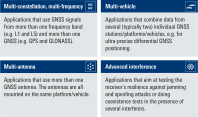
Special GNSS applications involve advanced techniques for enhanced navigation and positioning:

1. Multi-frequency and multi-constellation applications use signals from different satellite systems and frequencies for better precision.

2. Multi-vehicle applications enable cooperative navigation.

3. Multi-antenna applications improve signal reception.

4. Advanced inter¬ference applications tackle signal disruptions, ensuring accurate and reliable GNSS functionality in varied environments.

Figure 6: Overview of special GNSS applications

GNSS simulation and receiver testing

GNSS testing is crucial during receiver development and chipset/device production to ensure optimal performance. It characterizes receiver performance, tests special receiver features and assesses resilience against GNSS threats, such as jamming, spoofing and coexistence issues. Thorough testing helps maintain reliable and accurate positioning, navigation and timing information.

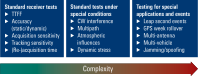
Figure 7: GNSS test cases at a glance

GNSS testing can be performed via real-world testing, but that has limitations such as unknown system conditions, restricted customization and the impossibility of repeatable tests. It is also time-consuming and expensive.

This is where simulation comes in. In a simulation, the system conditions are well defined, and test scenarios can be repeated as often as needed. The test parameters can also be configured according to user requirements.

There are seven elements that must be considered by a GNSS simulation:

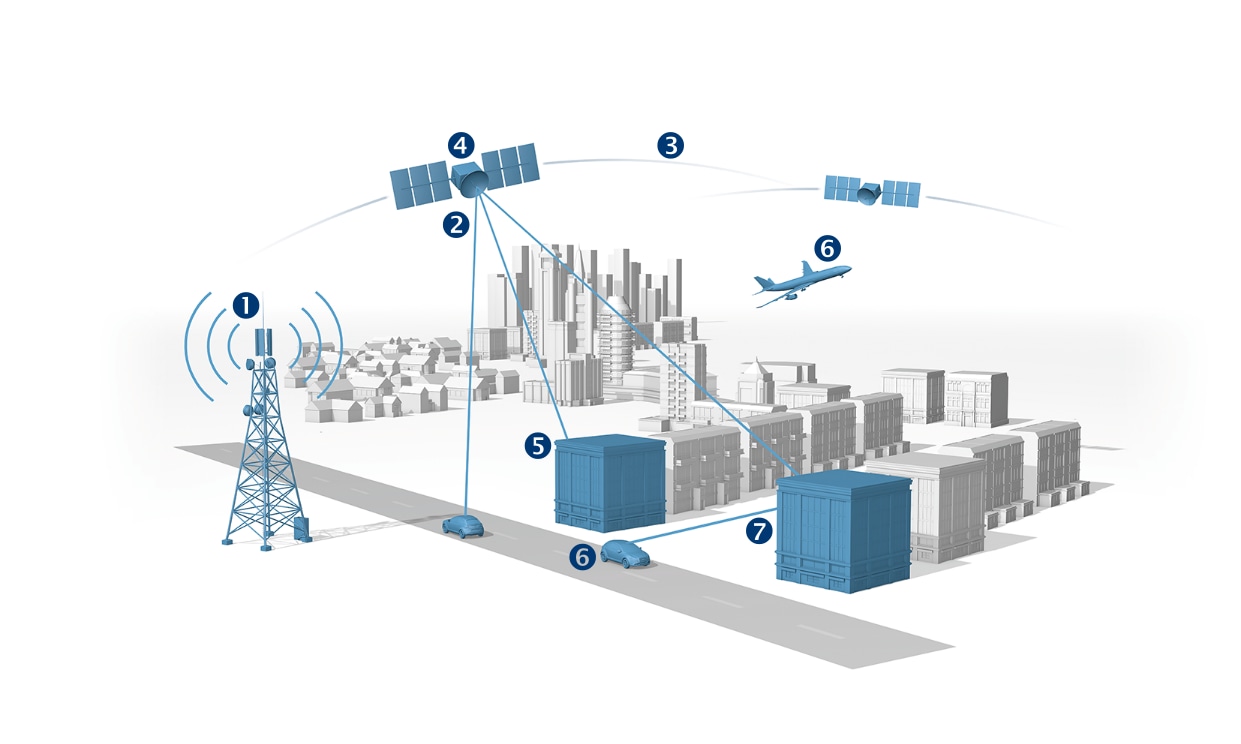
Figure 8: GNSS simulation requirements at a glance

1. Jamming and interference: To emulate a real GNSS environment, external influences such as jamming and interference signals must be considered. The presence of additional signals can then be simulated, and their influence on GNSS signal reception can be evaluated.

2. Range simulation: The range between the satellite and the receive antenna is the basic measurement a GNSS receiver performs to compute its position. For realistic range simulation, it is necessary to consider (a) ionospheric and tropospheric effects, (b) system-inherent errors such as clock errors and (c) unexpected ranging errors.

3. Satellite orbit simulation: A realistic GNSS simulation must support the simulation of different classes of satellite orbits (LEO/MEO/GEO/IGSO), including orbit errors and perturbations.

4. Systems and signals: Today, a GNSS simulator must support multi-constellation and multi-frequency scenarios, simulating all relevant systems and signals in all GNSS frequency bands at the same time.

5. Signal obstructions: GNSS signals are often obstructed by buildings - especially in urban environments. In many cases, signal obstruction needs to be combined with multipath simulation, since the line-of-sight signal might be completely obstructed and the receiver may process only the multipath components.

6. Vehicle movement: Many tests must simulate a moving receiver that accounts for vehicle attitude. To test moving receivers under high signal dynamics, the GNSS simulator must support scenarios where the simulated user is exposed to high velocities and accelerations.

7. Multipath simulation: To test receiver performance in the presence of multipath, a GNSS simulator typically offers various ways to simulate such influences. For example, this can include tapped delay or ground multipath models, statistical channel models or deterministic multipath models.

GNSS test solutions for enhancing PNT reliability

Rohde & Schwarz offers signal generators and software for GNSS simulation, covering everything from simple scenarios with one satellite up to multi-satellite constellations with multichannel, multi-frequency and interference scenarios. We also offer GNSS test automation options for our signal generators, so that you can perform fully-automated tests under controlled, repeatable conditions in the lab and on the production line.

Our vector network analyzers (VNA) are essential tools for developing GNSS receivers. VNAs are used to:

  • Test and optimize antenna performance
  • Assess filters and amplifiers for frequency response, gain and linearity
  • Ensure correct impedance matching
  • Measure the noise figure (a key performance indicator)
  • Aid in characterizing signal paths within the receiver system
  • Determine the isolation between different ports to prevent interference

For testing in development, qualification and production, we offer a wide range of oscilloscopes.

Satellite navigation pocket guide

Get your copy now!

Ready for an illustrated overview of satellite-based PNT technologies? Download our digital pocket guide or order a free printed version now!

Frequently asked questions (FAQs)

Sign up for our newsletter

Sign up for our newsletter

Stay up to date on upcoming trends and latest applications.

Looking to better understand satellite systems and get complex technology insights?

Simply fill out this form and we will get right back to you.

Marketing permission

Your request has been sent successfully. We will contact you shortly.
An error is occurred, please try it again later.