Direct-to-cell technology
DTC is not a formally standardized term within 3GPP. It also doesn’t describe a single, unified technology. Instead, it denotes an approach aimed at enabling satellite-based connectivity for widely deployed, commercially available LTE devices without requiring dedicated hardware or software modifications. The objective is to support fundamental communication services - such as messaging, voice and basic data transmission - in areas lacking terrestrial network coverage.
At a conceptual level, DTC relies on satellites equipped with advanced modem capabilities that emulate terrestrial base stations in orbit. It can therefore be understood as a pragmatic, early-deployment solution that introduces targeted adaptations (primarily on the network side) to extend cellular connectivity via satellite.
In its current form, DTC is closely aligned with LTE-based architectures, providing satellite connectivity to unmodified 4G devices. Future developments may incorporate 5G standalone networks; however, these would not initially include the full feature set defined in 3GPP Release 17 for NTN. Over the longer term, DTC is expected to be completely replaced by NR-NTN solutions, which offer greater efficiency and scalability. The primary advantage of DTC lies in its rapid time-to-market, while its main limitations stem from technical constraints that affect overall system performance. Additionally, spectrum allocation remains an open issue, with current approaches relying on spectrum sharing or the reuse of existing mobile satellite service (MSS) bands.
DTC does not rely on a dedicated technical specification. However, it is largely based on the 3GPP EUTRAN (LTE) framework, supplemented by proprietary adaptations defined by satellite network operators. These adaptations are designed to enable satellite-based radio access while maintaining compatibility with existing UE.
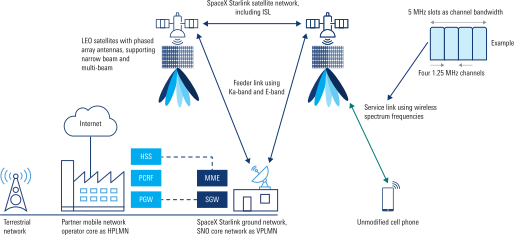
A key architectural constraint of DTC is the reliance on low Earth orbit (LEO) satellite constellations due to latency considerations. Operators pursue different deployment strategies, ranging from dense constellations at lower altitudes to sparser configurations at higher altitudes. In some implementations, conventional LTE base station functionality (eNodeB) is integrated directly into satellite payloads. This allows standard smartphones to connect using familiar terrestrial protocols. Traffic is then routed either through terrestrial infrastructure or via inter-satellite links within the constellation.
A central technical challenge lies in addressing physical-layer impairments specific to satellite communications, including Doppler shifts, propagation delays and polarization effects. In standardized NTN approaches, both the UE and the network must take on the responsibility of compensating for these issues. DTC, however, shifts this responsibility so that it lies primarily with the network. This design choice preserves compatibility with existing devices, but it also introduces certain trade-offs in efficiency.
The following technical aspects characterize current DTC implementations:
- Compatibility with unmodified commercial devices: The system is designed to present a satellite-based cell that appears indistinguishable from a terrestrial LTE cell. For this to work, it requires quasi-stationary beam patterns from LEO satellites and dense constellation deployments.
- Network-side compensation: Doppler effects are mitigated through pre-compensation techniques implemented at the base station level, typically referenced to a fixed point on Earth. Similarly, propagation delays are partially addressed through network adaptations, as LTE timing advance mechanisms alone are insufficient for satellite-scale distances. The satellite performs pre-compensation of Doppler effects in the downlink and post-compensation in the uplink, addressing both carrier frequency and sampling frequency offsets.
- Device-side considerations: While DTC aims to avoid modifications to UE, limited software updates may be introduced by vendors to improve performance under satellite conditions. Other challenges include increased carrier frequency offsets and rapid frequency variations during handovers between satellites.
- Satellite architecture: The long-time delay and challenges with random access restricts the DTC architecture to LEO constellations. As the satellite compensates for the Doppler effect, the beam footprint must be narrow, and the satellite must offer multiple beams in parallel for better capacity.
- Spectrum usage: No dedicated spectrum has been globally assigned to DTC. Current implementations depend on either shared spectrum arrangements with terrestrial networks or the repurposing of existing MSS frequency allocations, subject to regulatory approval.
- Network architecture and roles: The core network remains terrestrial, with the satellite network operator functioning as a visited public land mobile network (VPLMN), while the terrestrial mobile network operator acts as the home network (HPLMN). The HPLMN retains responsibility for end-to-end service management, including authentication, policy control and regulatory compliance.
In short, DTC represents a transitional solution that leverages existing LTE infrastructure to deliver satellite connectivity with minimal changes to user devices. While this approach enables rapid deployment, it also highlights the limitations of adapting terrestrial technologies to non-terrestrial environments without comprehensive standardization.