Digital multimeter vs. oscilloscope

Digital multimeter vs. oscilloscope

Speak to an expert

R&S®Essentials | Digital oscilloscope fundamentals

DMM vs. oscilloscope – which instrument do you need for your measurement?

The digital multimeter (DMM) and oscilloscope are two measurement tools that are found in almost every electronics lab. Even though they both measure voltage and have very similar-looking block diagrams, the outcome of their measurements are different. This article explains the differences between these two instruments and helps you find the right one for your application.

What is a digital multimeter (DMM)?

What is a digital multimeter (DMM)?

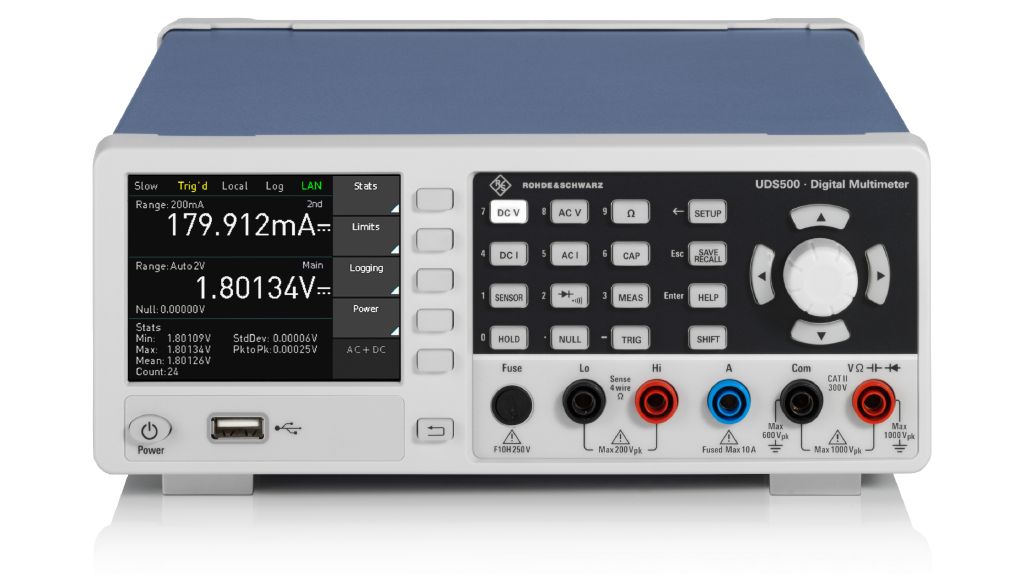
A typical digital multimeter (DMM) measures AC/DC voltage, AC/DC current, resistance, diode forward voltage, temperature and capacitance. The numeric result is often provided as an instantaneous value on an integrated display. However, some DMMs can also provide statistical information about a series of measurements.

In a nutshell: Digital multimeters can measure multiple signal parameters, but they can generally only perform one type of measurement at a time.

Oscilloscope

What is an oscilloscope?

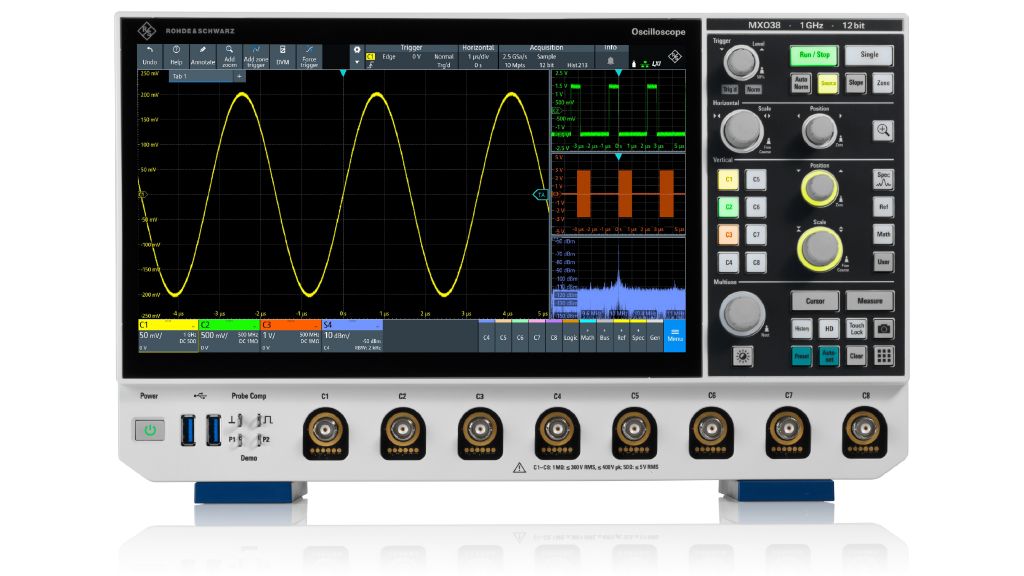
An oscilloscope primarily measures voltage across time and plots it as a waveform. Natively, oscilloscopes only capture voltage, but with probes, they can measure other quantities.

Once a waveform is acquired, oscilloscopes have extensive measurement and analysis capabilities. Voltage measurements can include peak-to-peak, top and base values in addition to root mean square (RMS).

Oscilloscopes generally have multiple input channels that allow them to measure and view multiple signals simultaneously, correlated in time or phase. Oscilloscopes also offer alternative views of the acquired waveform such as frequency vs. magnitude (FFT).

In a nutshell: Oscilloscopes can simultaneously measure multiple signals and multiple parameters.

What is the difference between a DMM and an oscilloscope?

Comparing the high-level block diagrams shows that both instruments have an analog-to-digital converter (ADC) at their core. In front of the ADC are some analog conditioning circuits, primarily an attenuator stage. While there are several fundamental differences between the instruments, each has a key block difference that separates their applications.

The multimeter block diagram has extra blocks, including a current source. Some of the DMM’s measurement modes use this current source. For example, the resistance mode uses this source to generate a known current through a shunt resistor and a resistor-under-test. Since the DMM knows the amount of current and the shunt resistor’s value, it can use Ohm’s law to determine the resistance value of the resistor-under test.

The oscilloscope has no such block, so an oscilloscope cannot measure resistance by itself. However, the oscilloscope does have a memory controller as well as memory for storing samples from the ADC. This buffer is how scopes can capture enough information to display waveforms.

In addition, oscilloscopes have sophisticated trigger systems that can help capture a wide variety of signal conditions. For example, an oscilloscope can update only when a pulse width violates a certain width (or time). Bench DMMs, on the other hand, may have a trigger input, but it is a simple start/stop signal.

DMMs and oscilloscopes also have different probing mechanisms, as you can see from their front panels.

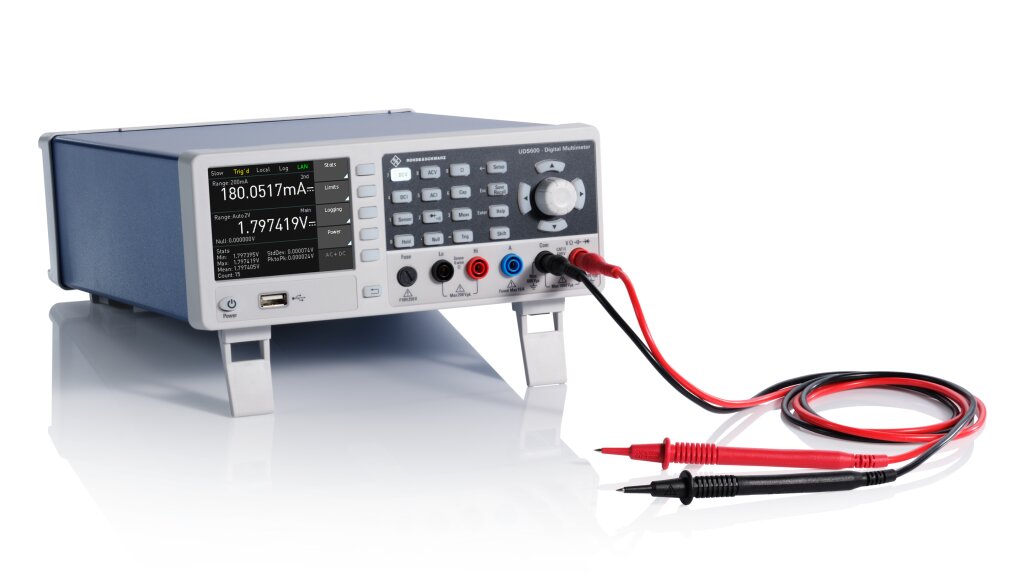
DMMs generally have 4 mm banana-style jacks that accept a variety of low-frequency test leads or probes. The most common test lead has a silicon jacket with the 4 mm connector at one end and a metal pointed tip on the other. These test leads are helpful for handheld or quick measurements.

An oscilloscope front panel typically has a BNC-style connector. These connectors accept many different types of probes, most of which measure voltage. Most oscilloscopes come with passive voltage probes suitable for a wide range of general-purpose measurements. There are also probes that use sensors to measure other electric quantities. For example, a probe with a hall-effect sensor converts a wire’s electromagnetic field into a voltage, enabling the oscilloscope to measure current.

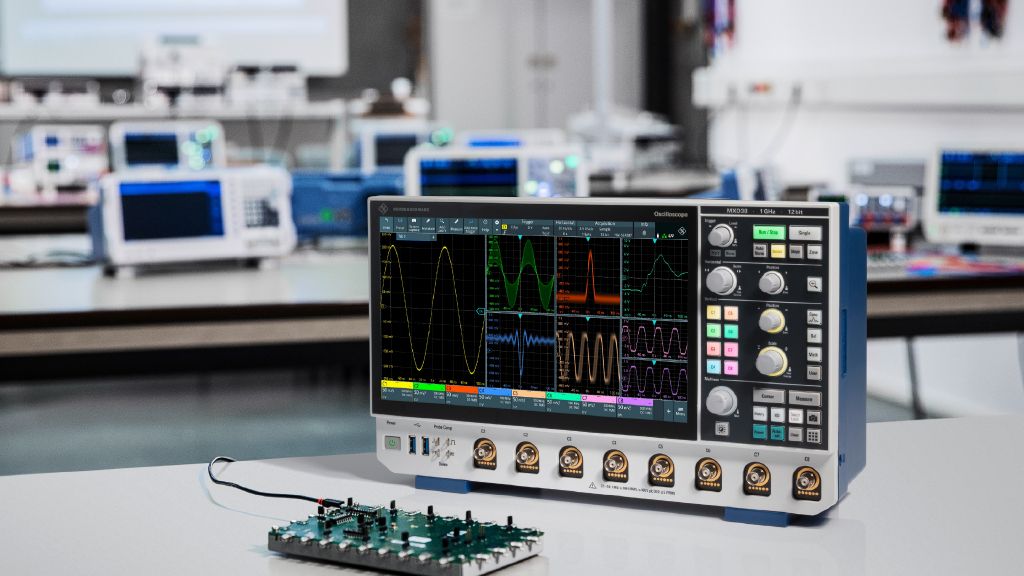
Direct cabling is an option for both DMMs and oscilloscopes. For example, if you’re using a text fixture, it may have 4 mm jacks or BNC (or other coaxial connectors) built in. You can connect the fixture to the DMM or oscilloscope using a cable with compatible connectors.

DUT cabled to oscilloscope

When to use an oscilloscope over a DMM and vice versa?

Perhaps your budget only allows for one of these instruments, or perhaps you have both but are unsure of which to use! The good news is that there are several measurement scenarios where it is obvious which one to use. The even better news is that both instruments work well in many cases.

A DMM is the better choice when you need to measure the characteristics of discrete devices. A DMM, such as the R&S®UDS, can measure specific aspects of a resistor, capacitor, diode or even a transistor. The R&S®UDS could measure, for example, the capacitance of a capacitor or forward drop of a diode. These measurements are helpful when designing a circuit or determining whether a component is damaged. For a complete characterization, however, you may want to consider an LCR meter, which measures the parasitics of a passive component.

DMMs are also good for measuring voltage or current with signals near DC. However, when measuring AC (if there is a frequency content above 100 kHz), a DMM might not correctly measure the signal since its bandwidth is limited.

Oscilloscopes, on the other hand, have very wide bandwidths and are excellent for measuring signals with high-frequency content. They can measure DC, but they present much lower loading to a DUT than a DMM. Oscilloscopes also have multiple time-correlated channels, so they are ideal for comparing a data signal with a clock or an enable signal.

In addition, an oscilloscope is often better for measuring the clock of a microcontroller. A DMM’s test leads have high capacitance, and its frequency measure might be limited to a few megahertz. An oscilloscope, however, puts less loading on the signal and typically has a much higher bandwidth.


Scenario Multimeter Oscilloscope
Verifying steady DC voltage O X
Measuring resistance/continuity O X
Debugging boot-up timing X O
Diagnosing signal edge ringing X O
Measuring current draw O X
Detecting random voltage dropouts X O
Evaluating PWM duty cycle X O
Inspecting supply rail ripple X O

An oscilloscope and DMM in one instrument

Nowadays, oscilloscopes often incorporate additional features. For example, it’s common for an oscilloscope to have function generation, either built in or as an option.

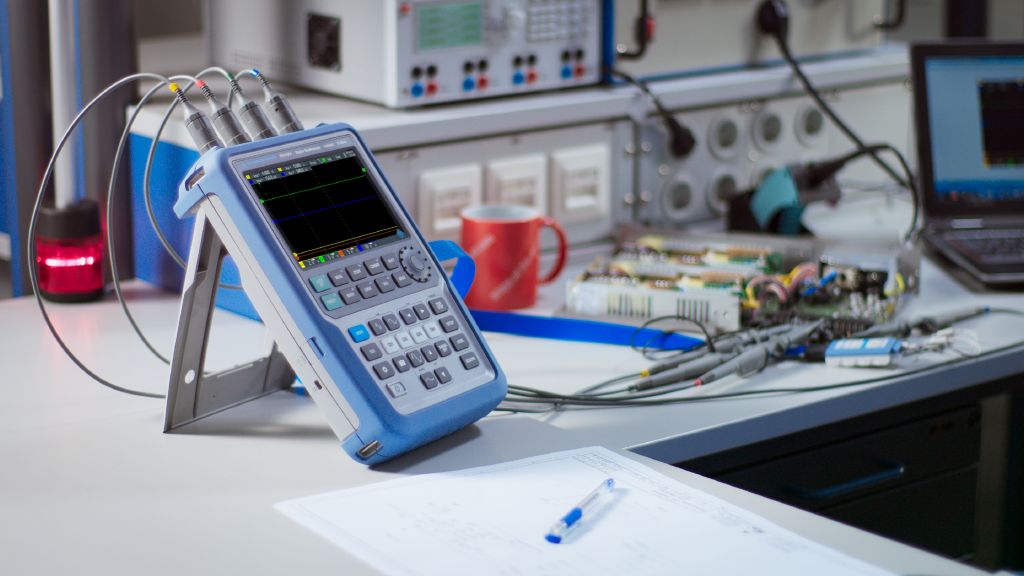
Similarly, there are also oscilloscopes that have built-in DMMs. An example of this is the two channel model of the R&S®Scope Rider handheld oscilloscope, which has a built-in DMM that measures AC/DC voltage, AC/DC current (with external shunt), resistance and capacitance.

R&S®Scope Rider
The R&S®Scope Rider handheld oscilloscope on a bench

Summary

An ideal lab would be equipped with both a DMM and an oscilloscope, but even then you’ll often have to choose the tool that best fits the task at hand.

A DMM is ideal when you need a single, high precision measurement: accurate DC voltage or current, low frequency AC voltage or current or specific component parameters.

An oscilloscope, on the other hand, is better for capturing and comparing multiple signals at once, analyzing high frequency content or visualizing a signal’s waveform.

Are you trying to pick the right instrument for your application? Our experts are here to help.

Curious to learn more about test fundamentals?

Sign up for our newsletter