Your task
Modern RF power amplifiers (especially GaN-based devices for 5G, 6G, radar, satellite and aerospace) are frequently operated near their nonlinear limits to maximize efficiency or increase output power. Traditional smallsignal S-parameters or scalar power measurements cannot fully capture device behavior.
When designing and validating amplifiers, engineers need to determine the optimum source and load impedance at the fundamental frequency and at harmonic frequencies. The harmonic terminations directly influence output power, efficiency, linearity, voltage swing, current waveform and device stress.
Conventional vector load-pull measurements provide valuable information about output power, gain, compression and efficiency relative to impedance.
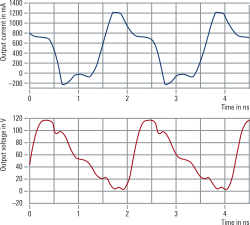
Advanced waveform engineering also needs calibrated magnitude and phase information about the incident and reflected RF waves. Only with this information can RF voltage and current waveforms at the reference plane of the device under test (DUT) be reconstructed and used to understand the real operating mode of a device.
This information is important when optimizing highefficiency amplifier modes, validating nonlinear models or correlating simulated and measured device behavior. The challenge is to combine accurate phase-calibrated wave measurements, harmonic impedance control and a practical load-pull workflow in one measurement environment.