How to measure M-MIMO beamforming downlink/uplink (DL/UL) conformance
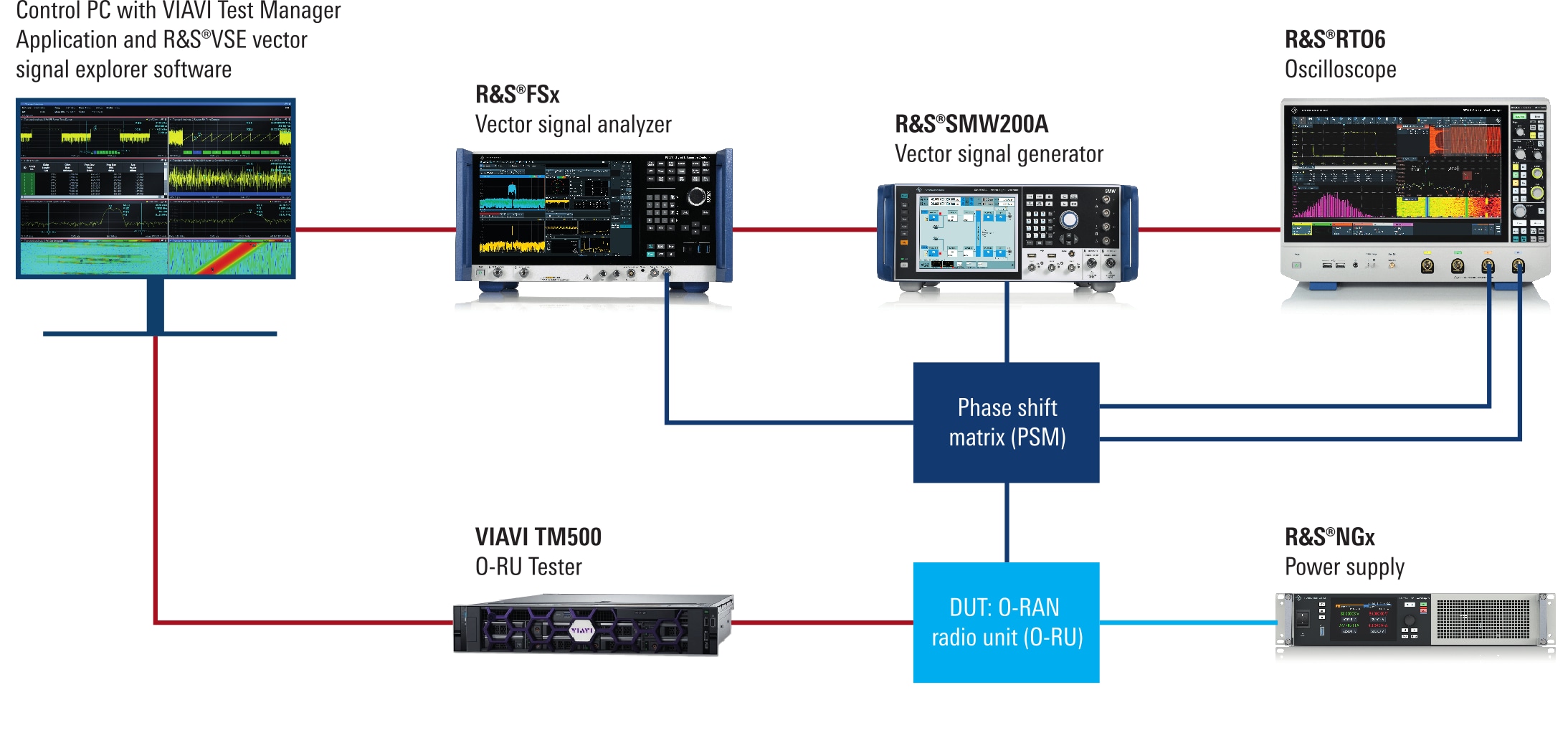
Once the test setup is configured, DL measurements start with the O-DU emulator inserting beam ID information into the I/Q packets and sending them over the open fronthaul (O-FH) interface to the O-RU.
After receiving and decoding the I/Q data stream, the O-RU reconstructs the waveform and transmits the RF signal over its antenna array. The signal is routed through the PSM to the R&S®RTO oscilloscope, where it is captured for analysis. Measurements are first taken across all antenna ports, followed by detailed evaluations of ports 2 through to the highest number supported by the O-RU (16, 32 or 64). The captured data is processed with R&S®VSE software and checked using predefined pass/fail thresholds.
Once all ports are measured, the system automatically generates result logs and summary files, with final values presented in a convenient table. If any antenna port exceeds the limits set by the test engineer, the test is flagged as a failure.
For uplink testing, the R&S®SMW200A vector signal generator creates the UL signal and feeds it into the PSM, which forms the matching uplink beam to the O-RU. The O-RU processes the received signal, and the resulting I/Q data is captured and analyzed by the TM500 O-RU Tester. The VIAVI O-TMA then provides a clear pass/fail report for all test results.