
Vérification eCall hybride
Test de conformité de bout en bout d'un module eCall hybride dans des conditions de réseau contrôlées en conformité avec la norme EN18052:2025

Test de conformité de bout en bout d'un module eCall hybride dans des conditions de réseau contrôlées en conformité avec la norme EN18052:2025

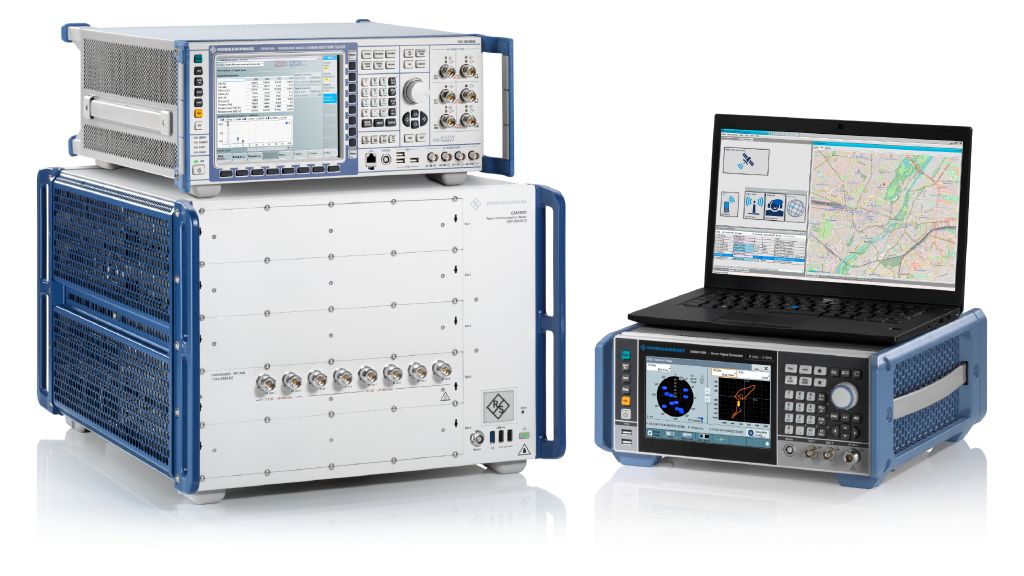
Configuration de test de conformité de bout en bout eCall hybride avec le testeur de communications radio R&S®CMX500, un testeur de communications radio large bande R&S®CMW500, un générateur de signaux vectoriels R&S®SMBV100B (comme simulateur GNSS) et un logiciel de vérification eCall hybride complet R&S®CMX-KA099
Il est obligatoire pour les systèmes eCall des véhicules modernes afin de prendre en charge la nouvelle génération (NG) des eCall (sous-systèmes multimédias IP (IMS) basés sur la voix et un ensemble minimum de données (MSD) sur la 4G/5G) et il est fortement recommandé qu'ils restent compatibles avec les anciens systèmes eCall qui utilisent des réseaux à commutation de circuits (2G/3G) comme solution de secours. Les fabricants doivent valider des implémentations hybrides afin de s'assurer qu’elles déclenchent des appels, émettent l'ensemble minimum de données (MSD), maintiennent le positionnement GNSS et fournissent une qualité de voix intelligible sur toutes les combinaisons de réseaux (voix sur New Radio (VoNR) / voix sur LTE (VoLTE) – solution de secours à commutation de circuit (CS)). Les tests doivent démontrer qu'un système reste robuste lorsqu'il est confronté à des transferts, des conditions radio dégradées et une conformité aux normes (CEN/ETSI/3GPP et règles nationales).
Rohde&Schwarz propose un système de test pour les modules eCall hybrides (voir „Hybrid eCall test setup“). Ce système utilise :
La plateforme de test Rohde&Schwarz permet une vérification complète à la fois des anciens eCalls et des NG eCalls dans un environnement de laboratoire contrôlé unique avec le CMX500 et le CMW500. En émulant des appels VoNR/VoLTE basés sur IMS, des solutions de secours à commutation de circuits et des conditions GNSS réalistes, les fabricants peuvent valider la fourniture du MSD, la continuité d'appel, les transferts et la précision de la position sur toutes les combinaisons de réseaux. Cette capacité augmente la sécurité et la résilience de couverture en assurant des connexions plus rapides et plus fiables aux points de réponse de sécurité publique (PSAP), en réduisant le nombre d'appels d'urgence omis ou retardés et en fournissant une preuve mesurable pour la certification et les évaluations de sécurité fonctionnelle.
Avantages pour les équipementiers (OEM)
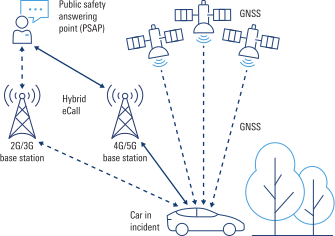
La spécification de test eCall hybride EN18052 établit qu'un système hybride doit combiner différents trajets de transmission et des protocoles pour assurer qu'un eCall atteigne de manière fiable sa destination. En pratique cela signifie qu'un véhicule utilisera des fonctions NG eCall (voix basée sur IP/IMS et données sur 4G/5G) mais pourra automatiquement revenir à des trajets de transport eCall CS classiques disponibles (2G/3G) lorsque la couverture ou la qualité de service se dégrade. L'approche hybride fournit une redondance avec une sélection de domaine automatique et une solution de secours fluide entre les trajets de transport NG (IP/IMS sur 4G/5G) et anciens CS (2G/3G) en prenant en charge les transferts d'appel.
Un système hybride permet une fourniture parallèle ou répétée du MSD, prend en charge un transfert MSD alternatif avec un modem dans la bande dans le domaine à commutation de paquets (PS) lorsque l'accusé réception de la couche d'accès (AL‑ACK) est négatif ou manquant, et définit le comportement des tentatives, les changements de domaine et les scénarios de rejet/délai d’attente. Le système intègre un auto-test et une indication d'erreur, permet des appels après des changements de domaine, et maintien l'inscription pendant les périodes requises (incluant le service limité et eCall) afin de garantir un rapport de position robuste, une meilleure tolérance aux pannes et une meilleure accessibilité pour les services d’urgence lors de la transition des réseaux hérités vers les réseaux NG.
La plateforme de test modulaire Rohde & Schwarz permet une vérification complète de l'eCall hybride, NG et ancien dans un environnement de laboratoire contrôlé. En combinant la simulation cellulaire et GNSS avec une émulation PSAP et un séquençage de test automatisé, le système assure un appel d'urgence robuste, une fourniture MSD fiable et une conformité démontrable avec les normes en vigueur.
Related products