
Automotive NTN testing

NTN automotive testing

Speak to an expert

Automotive applications of NTN and how to test them

Ensuring the always-connected vehicle with NTN

Automotive OEMs aim to deliver a seamless user experience for safety, ADAS and infotainment services – regardless of where the vehicle is located. Today these services are delivered primarily via terrestrial networks, but significant coverage gaps still exist in, for example, sparsely populated rural areas or when the terrestrial network infrastructure is damaged due to conflict or environmental disaster.

Non-terrestrial networks (NTN) can provide wireless connectivity even in areas that are not covered by terrestrial networks. OEMs, government organizations and industry bodies are actively exploring the role that NTNs can have in providing ubiquitous connectivity and ensuring the always-connected vehicle.

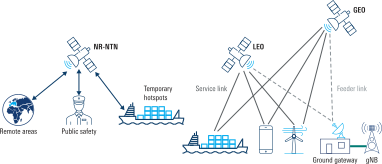
The emerging technology of NTN presents a multi-dimensional landscape that spans proprietary and standards-based implementations, such as NB-NTN, NR-NTN and D2C, as well as multiple frequency bands (L, S, Ku, Ka) and satellite constellations (LEO, MEO, GEO).

Rohde & Schwarz draws on its extensive wireless and automotive expertise to help you navigate the new challenges of NTN, identify key vehicle components and explain the role of testing in developing NTN-enabled vehicles.

NTN technology challenges

Automotive NTN connectivity introduces a range of RF, mobility and system-level challenges that must be addressed through rigorous testing:

  • Large propagation distances and high pathloss: Unlike terrestrial networks with cell sizes of only a few hundred meters, NTN links span hundreds of kilometers to LEO satellites and roughly 36,000 km to GEO satellites. These extreme distances create significant pathloss and, in the case of GEO systems, substantial latency. High latency complicates timing synchronization and limits support for reactive automotive use cases.
  • Low and variable satellite elevation angles: Maintaining a line-of-sight connection becomes difficult when satellites appear at low elevation angles, particularly for GEO systems viewed from high latitudes. Shadowing from terrain, foliage and the vehicle environment can further degrade service continuity. Antenna designers and OEMs must account for these conditions to ensure reliable operation across diverse driving scenarios.
  • Signal distortion from atmospheric effects and multipath: Atmospheric fading and multipath reflections from the surrounding environment distort NTN signals, reducing link quality. These impairments influence NTN network design and must be addressed during chipset and vehicle-level integration.
  • Satellite movement and Doppler effects: For non-geostationary earth orbit (NGEO) systems, the relative motion between the satellite and vehicle generates Doppler shifts and time-varying propagation delays. These effects introduce demanding synchronization and RF-channel challenges for the TCU and chipset. Vehicles may require active, beamforming antennas to continually track fast-moving LEO satellites, which are visible for only minutes at a time.
  • Complex NTN mobility and handover procedures: NTN adds multiple mobility requirements beyond those of terrestrial networks, including inter-beam and inter-satellite handover, cell reselection, and transitions between NTN and TN networks. Particularly for LEO constellations, ensuring seamless mobility demands careful network design and testing of conditional handover parameters and trigger points at the vehicle level.
  • Wide range of operating frequency bands: NTN systems operate from L and S bands up to Ku, K and Ka bands. While current automotive TCUs and antennas may already support lower bands, higher-frequency Ku/K/Ka operation introduces significantly more complex requirements for RF transceivers, TCUs and antennas.
  • Space, power and thermal constraints: Beamforming-capable active antennas needed for high-frequency NTN operation increase size, weight, power consumption and thermal load. These constraints must be balanced against vehicle design, cost and integration considerations.

Master your automotive NTN test challenges

Realizing the always-connected vehicle also requires emulating complex NTN conditions and validating end-to-end performance:

  • Flexible NTN network emulation: To evaluate chipset, TCU and vehicle-level performance over a wide range of NTN implementations, test systems must emulate LEO, MEO and GEO constellations, all relevant frequency bands and all appropriate mobility conditions.
  • Standards-compliant protocol, RF and application testing: Chipsets and TCUs require testing against 3GPP NTN specifications - including NB-NTN and NR-NTN - to verify correct protocol behavior, RF performance and application-level operation. This ensures regulatory requirements are met and enables compatibility with other devices.
  • Advanced channel emulation: To ensure correct operation on the road, pathloss, fading, shadowing, atmospheric effects and Doppler frequency shift must be replicated in the lab to emulate realistic NTN channel conditions.
  • Timing and frequency synchronization verification: Accurate validation of timing behavior - especially under GEO latency and NGEO Doppler shift - is critical for ensuring correct operation of NTN communication systems.
  • Emulation of realistic GNSS signals: As GNSS plays a central role in NTN positioning, timing and mobility procedures, test environments must emulate multiple GNSS satellites alongside NTN signals.
  • Antenna and beamforming validation: Both passive and active automotive antennas require OTA lab and chamber testing to verify beam steering, gain, performance and robustness under varying elevation angles and satellite trajectories.
  • Vehicle-level validation of NTN-based services: End-to-end services delivered over NTN, such as eCall, must be tested in integrated vehicle environments to ensure correct operation under real-world NTN conditions.

NTN implementations comparison

NTN Implementation Advantages Challenges Potential supported automotive use cases
NB-NTN Constellations already operational Low data rate
Limited ability to support services
Emergency call
Stolen vehicle recovery
Basic telematics
NR-NTN Able to support higher data rate services Requires large and power-hungry active antenna
RF transceiver design more complex
Teleoperated driving support
OTA firmware updates
Infotainment services
D2C Able to provide immediate connectivity with no modification to vehicle Recertification required Voice calls
Messaging
Proprietary Operational So far LTE only
Compatibility, interoperability, availability of chipsets, TCUs
Internet browsing, video streaming

Our automotive NTN test solutions

  • Multi-orbit support, covering LEO, MEO, GEO and GSO, as well as both inter- and intra-orbit handovers
  • Multiband support covering all NTN frequency bands
  • Dynamic Doppler shift emulation for both uplink and downlink signals
  • Variable propagation delay and round-trip time (RTT) emulation, with the ability to assess the impacts of timing advance, HARQ retransmission process and overall latency
  • NTN-specific fading profiles that incorporate effects such as atmospheric attenuation, rain fading and combined atmospheric/terrestrial fading
  • Flexible GNSS signals emulation covering all global standards
  • Complete active and passive antenna characterization solutions including far-field transformation
  • Fast and efficient TCU production testing solutions
  • Conformance testing of the TCU in accordance with the appropriate 3GPP release
  • Full vehicle OTA testing to ensure end-to-end operation, co-existence and interference robustness

Benefits of our solution

  • Security of investment from a future-proof solution that can to emulate all standards-based NTN frequency bands and implementations
  • Efficiency from using a single instrument (R&S®CMX500) to cover network emulation, fading profiles, Doppler effects and timing challenges.
  • Confidence from using proven test solutions adopted by OEMs, chipset suppliers and TCU vendors.

If you require any information, please contact us.

Our automotive NTN test solutions products

R&S®CMX500 radio-communication tester

Key facts:

  • Multiple NTN technologies emulation, including NR-NTN, NB-NTN, and Direct-To-Cell (D2C, DTC)
  • Multi-orbit support, covering LEO, MEO, GEO and GSO, as well as both inter- and intra-orbit handovers
  • Multiband coverage: L-Band, S-Band, Ku-Band and Ka-Band

More information

R&S®SMBV100B GNSS simulator

Key facts:

  • GNSS signal generation for GPS, Glonass, Galileo, BeiDou and QZSS/SBAS
  • Realistic modelling of GNSS orbits, propagation effects and system errors
  • Ideal tool for single and multi-frequency receiver testing

More information

R&S®ATS1000 Antenna test system

Key facts:

  • Extremely fast and accurate 3D antenna characterization
  • Direct far field system with 5 cm quiet zone size
  • Designed for maximum compactness and mobility

Mehr Informationen

Full Vehicle Antenna Test system

Key facts:

  • Complete passive and active antenna characterization at vehicle level
  • Ensure vehicle communications system performance
  • Coverage of all vehicle wireless standards

More information

TS8991OTA performance test system

Key facts:

  • Passive antenna measurements with near field to far field transform
  • OTA testing for all major cellular and non-cellular technologies
  • Can be combined with radiated spurious emission and EMC

Mehr Informationen

NTN automotive testing FAQs

Sign up for our newsletter

Stay up to date with the latest news, information and resources

Sign up for our automotive newsletter

Informationen anfordern

Do you have questions or need additional information? Simply fill out this form and we will get right back to you.
For service/support requests, please go here to log in or register.

Marketing-Einverständniserklärung

Ihre Anfrage wurde erfolgreich versendet. Wir nehmen in Kürze Kontakt mit Ihnen auf.
An error is occurred, please try it again later.